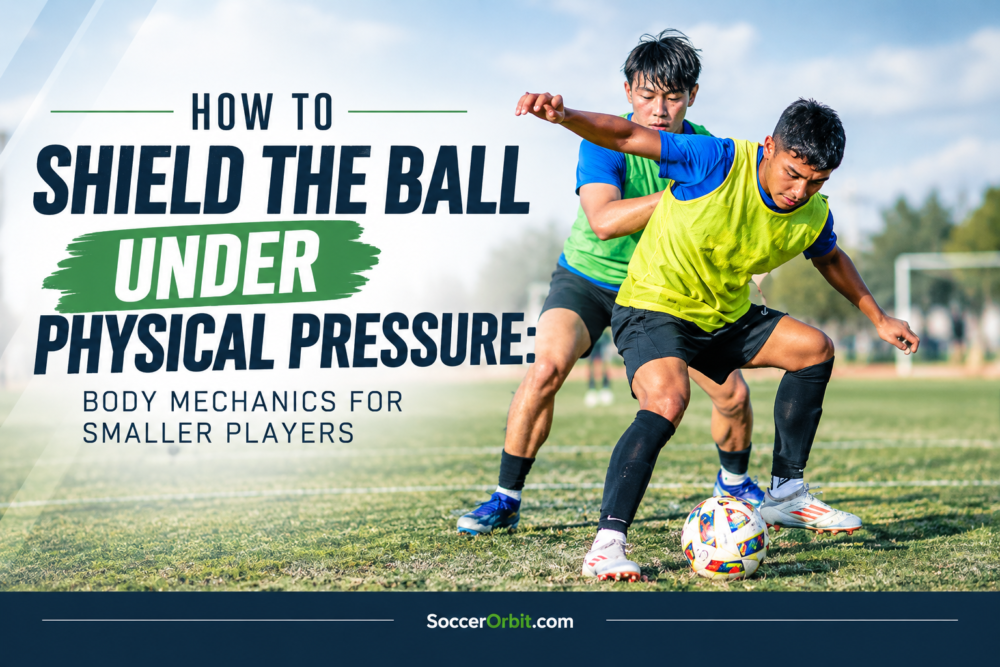
The secret to learning how to shield ball soccer players face against bigger defenders lies in understanding that the strongest player in a duel is not always the one who wins it, because balance, body position and the timing of a touch can make an awkward contest surprisingly difficult for a stronger opponent.
For a smaller player, receiving the ball with a defender approaching from behind can feel like being asked to hold a door shut against someone twice your size, especially when the first instinct is to stand upright, plant both feet and hope the referee notices the pushing.
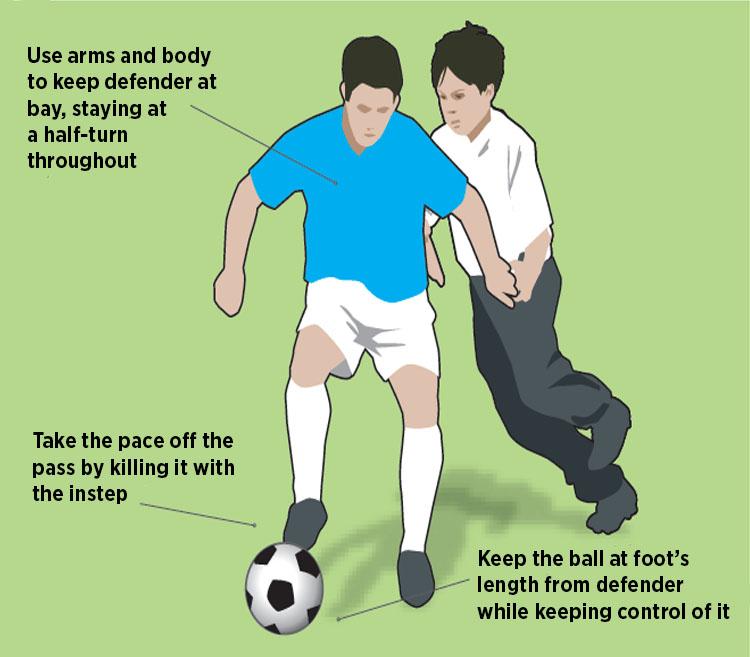
There is a better way. Shielding involves placing your body between the opponent and the ball, using your hips and shoulders to control the space around you, and keeping the ball on the side the defender cannot easily reach.
England Football’s coaching guidance describes this as learning to hide the ball, a skill that helps young players retain possession long enough to turn, carry the ball into space or find a teammate.
The aim is not to win a wrestling match with a centre-back who spends his weekends moving strikers out of the way. It is to make his physical advantage less useful while giving yourself more time to decide what happens next.
Why Smaller Players Can Shield The Ball Effectively
Height and body mass influence physical contests, yet shielding depends heavily on how a player positions the body relative to the opponent and the ball. A smaller player who establishes that position early can force a larger defender to reach around, adjust their feet or take a less direct route towards possession.
The key is to stop thinking about shielding as standing still and absorbing contact. Effective shielding is an active movement skill involving balance, controlled contact, footwork, awareness and decisions about when to release the ball.
A player’s ability to keep possession under pressure also depends on controlling the ball cleanly on arrival, especially when a defender is close enough to challenge the first touch.
Using the body to protect possession, maintaining balance under pressure and separating from opponents through changes of direction and acceleration are important player-development qualities.
That gives us a practical starting point: build a stable body position, keep the ball away from the opponent’s strongest route, and remain ready to move rather than becoming a stationary target.
The Body Mechanics That Make Shielding Work
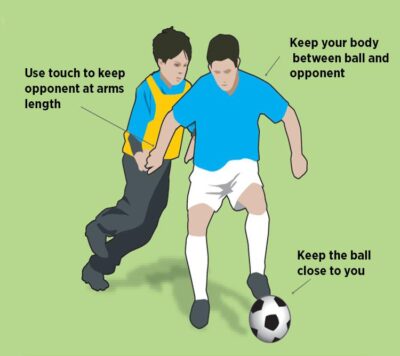
Before working through the drills, understand four physical principles that make shielding more effective for smaller players.
- A lower centre of mass: Bending your knees and hips slightly helps you maintain balance and adjust to contact without becoming rigid.
- A stable base: Keeping your feet comfortably apart gives you room to shift your weight, turn or take a recovery step when the defender applies pressure.
- A body barrier: Placing your torso and hips between the opponent and the ball makes a direct tackle harder to execute.
- Controlled movement: Using small touches and adjusting your feet prevents the ball from drifting into the defender’s reach.
These are practical coaching principles rather than a formula that guarantees possession, since the direction of contact, the quality of the opponent’s challenge and the available space all affect the outcome.
READ ALSO | How to Practice Soccer Alone Without Any Equipment (No Cones Required)
How To Shield The Ball Step by Step
Step 1: Scan before the ball arrives
Check over both shoulders before receiving a pass, paying particular attention to where the nearest defender is approaching from and whether a teammate is available for a quick layoff.
If pressure is coming from behind, adjust your body angle while the ball travels so that your first touch moves away from the defender rather than inviting them straight into you.
This early information gives you a useful advantage because you can prepare your stance before contact begins, instead of trying to solve the entire problem after a defender has already reached you.
Step 2: Receive on the far foot
Imagine a defender approaching your right shoulder while the pass arrives from midfield. Whenever the pass allows it, use your left foot to receive the ball on the side farthest from that opponent.
Your body then sits between the defender and possession, reducing the defender’s direct access while leaving you able to move the ball across your stance.
If the ball arrives on the wrong side, use your first touch to move it across your body when space permits, rather than stretching awkwardly and allowing the defender to poke it away.
Step 3: Lower your hips and bend your knees
Adopt a slightly crouched athletic stance with your knees bent, hips lowered and feet roughly shoulder-width apart, keeping your weight balanced over your feet instead of leaning heavily backwards.
Your chest should remain reasonably upright, your head should stay available for scanning, and your knees should remain flexible enough to absorb normal contact and make quick adjustments.
Avoid sitting so low that you struggle to turn, or leaning your entire body into the defender, because both habits can leave you slow to react when the opponent changes direction.
Step 4: Turn your shoulder and hip towards the pressure
Position your body at an angle rather than standing square to the defender, allowing your shoulder and hip to create a barrier while your feet remain ready to move the ball.
You should feel the opponent’s presence without surrendering your balance, and you should be able to pivot away if they try to move around your outside shoulder.
The objective is to occupy the useful space between the opponent and the ball, not to shove the opponent away or make contact simply for its own sake.
Step 5: Use your arms for balance and awareness
Keep your arms slightly away from your sides in a natural position, using them to help balance your movement and sense where the opponent is without grabbing, pushing or striking.
Arms can help you maintain balance and recognise an opponent’s position while shielding, provided you avoid extending them to hold the defender off illegally.
For young players, the distinction matters: an arm used for balance is different from an arm extended to hold a defender off, and illegal holding or pushing can give away a free kick.
Step 6: Keep the ball moving with small touches
Use gentle touches with the sole, inside or outside of your foot to move the ball around your stance, choosing whichever surface gives you control without exposing it to the approaching defender.
Keep the ball close enough to adjust quickly, especially when the opponent is within tackling distance, and use the foot farthest from the defender whenever the angle makes that possible.
Practising this technique in a confined area teaches you to keep the ball outside an opponent’s immediate reach without allowing it to roll beyond your own control.
Step 7: Pivot when the defender commits
When a defender leans heavily into one side or reaches towards the ball, use that movement as information and pivot away if the opposite direction remains open.
For example, if the defender crowds your left shoulder, a controlled touch across your body followed by a turn towards your right may create the separation needed to escape.
Do not force the turn merely because it looks skilful, since retaining possession and finding a teammate may be the better decision when another defender is already closing the exit.
Step 8: Decide whether to turn, pass or hold up play
Once you have protected possession, assess whether you can advance, turn into space, play a simple pass or continue shielding while teammates move into useful positions.
Good hold up play soccer tips begin with recognising that possession has a purpose: a forward may need to wait for midfield support, while a midfielder might only need a second to release the ball to a free teammate.
Learn to stay on the ball long enough to exploit an opportunity rather than automatically passing at the first sign of pressure.
READ ALSO | 15-Minute At-Home Soccer Ball Mastery Routine
Three Training Drills For Smaller Players
1. The 30-second shielding square
Equipment: One ball and four cones.
Set up a 4-by-4-metre square and pair up with a teammate, starting with one player shielding and the other attempting to win the ball without committing a foul.
- Shield the ball for 30 seconds while keeping it inside the square.
- Use your far foot, bent knees and small pivots to maintain possession.
- Swap roles and repeat for four rounds, resting briefly between efforts.
This exercise helps players become accustomed to contact in a controlled setting while developing balance, footwork and awareness under pressure.
2. Receive, protect and release
Equipment: One ball and two players.
Stand with your back partly towards a defender while a teammate passes the ball into your feet, then practise controlling the delivery and protecting it from a gentle challenge.
- Scan before the pass arrives and adjust your body angle.
- Receive on the foot farthest from the defender when possible.
- Shield for two or three seconds before returning the ball or turning into space.
Complete eight to ten repetitions each, gradually increasing the defender’s pressure as your technique improves.
3. Shield, escape and score
Equipment: One ball, cones and a small goal.
Create a small playing area with a goal or dribbling gate at one end, then receive the ball with a defender behind you and attempt to protect possession before escaping.
- Shield the ball for two seconds while checking the defender’s position.
- Turn towards the available space or use a teammate as a passing option.
- Accelerate through the gate or finish in the goal once you create separation.
Play six to eight short rounds per player, rewarding a successful escape or intelligent pass rather than measuring success only by goals scored.
Common Shielding Mistakes To Avoid
- Standing upright: A high, stiff stance makes it harder to adjust your feet when pressure arrives.
- Leaning backwards: Excessive backward movement can compromise balance and make turning difficult.
- Keeping the ball under the nearest foot: Placing possession on the exposed side invites the defender to poke it away.
- Extending the arms to push: Using your hands to hold off an opponent can turn a good shielding position into a foul.
- Holding the ball too long: Shielding should create time for a useful action, not become an excuse to ignore an open teammate.
- Watching the ball constantly: Scanning before and during possession helps you recognise pressure and choose an exit before the space disappears.
READ ALSO | 10 Wall-Ball Drills to Dramatically Improve First Touch and Passing Accuracy
Is Shielding The Ball Allowed Under Football’s Rules?
Yes. Under Law 12 of the IFAB Laws of the Game for 2026/27, a player may shield the ball by positioning their body between an opponent and the ball while the ball remains within playing distance, provided they do not hold off the opponent with their arms or body. The opponent may still make a fair challenge.
That means players should learn to protect possession through positioning and controlled movement rather than assuming that putting their body in the way gives them unlimited protection from contact.
Coaches and parents should also make sure young players practise against teammates of different sizes and abilities, with pressure introduced gradually and contact kept appropriate for their age and experience.
How Smaller Players Can Become Harder To Dispossess
The answer to how small soccer players protect the ball from bigger defenders comes down to preparation, balance and decision-making, with the most effective players learning to use their bodies to create time rather than trying to match every opponent’s strength.
Practise scanning before receiving, lowering your hips, keeping the defender on one side of your body and moving the ball with your far foot, then build towards realistic one-on-one situations where you must decide whether to turn, pass or hold possession.
A bigger defender may have the advantage when both players reach the ball at the same moment, yet the player who prepares earlier and understands where to place the ball can make that physical advantage much less useful.
The aim is not to become impossible to push off the ball. It is to become difficult to dispossess because you are already balanced, already aware and already deciding what comes next.
For defenders, this progression can also include practising how to deal with high balls, control aerial deliveries and clear danger under pressure, particularly when working on the defensive skills needed to handle match situations.
Is this helpful so far?