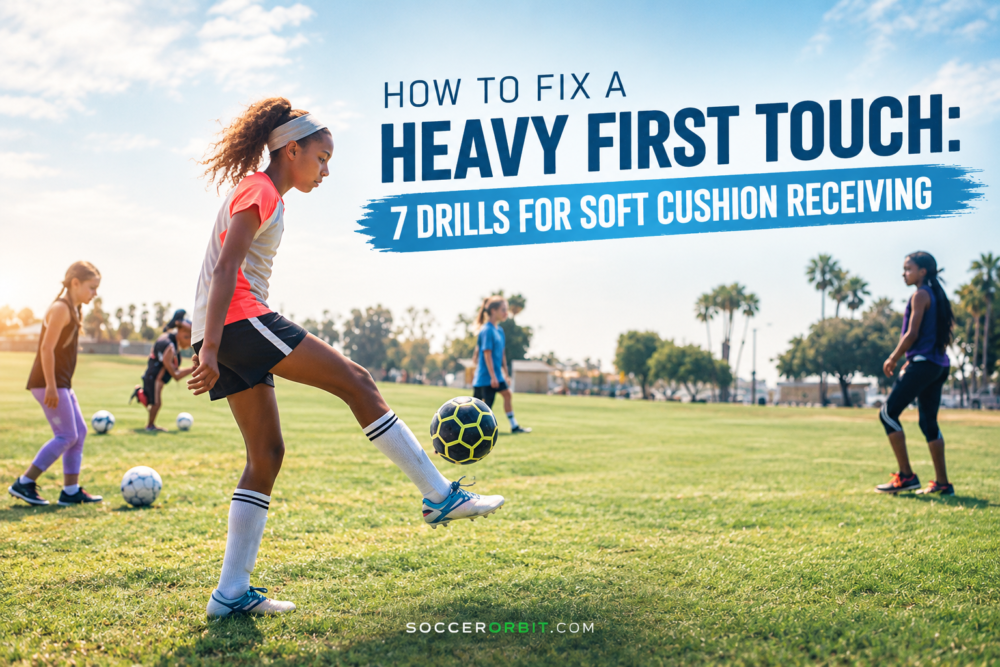
Learning how to improve first touch soccer starts with understanding why the ball keeps escaping in the first place. A heavy first touch usually comes from a rigid receiving foot, poor body position, arriving too late to the ball or trying to stop a pass that should have been guided into space.
Watch a good player receive a firm pass and the difference can look almost unfair.
The ball arrives with pace, yet after the first contact it seems to lose its temper and settle exactly where the player needs it. There is no great mystery behind that softness.
FIFA coaching material describes cushioning as a soft initial contact that reduces the ball’s pace while preparing it for the next action, while its receiving practices repeatedly emphasise body orientation, scanning, movement and purposeful first touches.
The encouraging part is that a heavy touch is highly trainable.
For beginners and developing players, the biggest mistake is usually trying to fix everything at once.
Start with the contact, then add movement, direction, pressure and finally aerial balls. That progression gives the feet a chance to learn the skill before the brain has to solve a small football puzzle at the same time.
Why Is My First Touch So Bad?
A poor first touch rarely comes from one technical problem, because receiving is a sequence involving what happens before the ball arrives as much as what happens when the foot meets it.
Common causes include:
- A stiff ankle at the moment of contact
- Standing flat-footed and waiting for the ball
- Receiving with the wrong foot
- Watching only the ball instead of scanning the surrounding space
- Facing squarely towards the passer when a side-on position would be more useful
- Trying to stop the ball completely when the next action requires movement
- Practising only slow, predictable passes and then expecting the technique to survive match pressure
The Football Association recommends moving towards the path of the ball rather than waiting for it, while FIFA coaching guidance stresses that body orientation affects where the player can receive and how effectively the first touch can take the ball into space.
There is also a simple reality that young players sometimes discover the hard way: a first touch has a job.
If a defender is closing from your right, a touch towards your right foot may be technically clean and tactically disastrous.
The aim is therefore not to produce a perfectly stationary ball underneath your body every time. The aim is to receive the ball in a way that gives you the next action.
READ ALSO | Solo Goalkeeper Training Drills: Handling, Agility, and Footwork Without a Shooter
The Basic Mechanics Of A Soft First Touch
Before getting into the drills, learn one movement properly.
When a firm ground pass arrives, avoid locking the receiving foot against it like a brick wall. Present the appropriate surface, keep control through the ankle and allow the foot to give slightly as the ball arrives, taking some energy out of the pass.
FIFA’s current coaching material specifically recommends a relaxed ankle when performing a soft turn, while its work on first-touch direction encourages players to use the receiving foot and body orientation according to the next action.
For many ground passes, the inside of the foot is the easiest surface for beginners because it provides a broad contact area, while the outside can become useful for turning and protecting the ball.
Think less about stopping the ball and more about absorbing and placing it.
That difference changes the entire training session.
1. Wall Cushion Drill
This is the simplest place to start because the wall gives you an endless supply of passes and removes the embarrassment of having to ask a teammate for the ball every five seconds.
Once this basic exercise becomes comfortable, you can build on it with more wall-ball variations that challenge your first touch, passing accuracy and ability to control the ball at different speeds.
Purpose: Learn to absorb the pace of a ground pass.
Equipment: One football, a solid wall and roughly 3 to 5 metres of space.
Step by step
- Stand about 3 metres from the wall with your knees slightly bent and weight on the balls of your feet.
- Pass the ball firmly against the wall with your right foot.
- As the ball returns, move your left foot towards its path rather than waiting for the ball to arrive underneath you.
- Present the inside of your foot to the ball.
- At contact, allow the receiving foot to move slightly backwards with the ball.
- Let the ball settle approximately one step in front of you.
- Pass it back using the opposite foot.
- Continue for 30 repetitions on each side.
The backward movement should be small and controlled, because pulling the foot away too dramatically simply creates another version of a bad touch.
Once comfortable, increase the pace of the pass.
The ball should still remain close enough for your next action.
2. Cushion and Push Through a Gate
Once the basic contact improves, the next job is teaching the player that the first touch should have somewhere to go.
Purpose: Turn a soft touch into a directional touch.
Set-up: Place two cones about 2 metres apart, creating a gate, roughly 3 to 5 metres in front of you.
Step by step
- Pass the ball against a wall.
- As it returns, open your body slightly.
- Decide whether you will receive towards your left or right before the ball reaches you.
- Cushion the ball diagonally through the chosen gate.
- Follow the ball through the gate.
- Collect it and pass against the wall again.
- Alternate directions every repetition.
- Complete three sets of 15 to 20 receptions.
FIFA uses similar first-touch exercises in which the receiver allows the ball to travel across the body towards the farther foot before pushing it forward through a gate.
This is one of the most useful heavy first touch fixes in soccer because it teaches the player to judge the quality of the touch by what happens next, rather than by whether the ball stopped perfectly.
3. Back-Foot Receiving Drill
The foot closest to the ball is not always the best foot to use.
If a pass comes from your right and you can receive it with your left foot, the back foot can help you open your body and move away from the passer in one action.
Purpose: Improve body shape and directional control.
Step by step
- Place two cones approximately 5 metres apart.
- Stand at one cone while a partner stands at the other with the ball.
- Move slightly away from the cone to create an angle for receiving.
- Open your body so you can see both the passer and the space behind you.
- Ask the passer to play the ball towards your far foot.
- Receive with the back foot.
- Cushion the ball across your body.
- Take your next step into the available space.
- Return the pass and repeat from the opposite side.
FIFA’s Michael Beale specifically recommends back-foot receiving because using the foot furthest from the ball can help players turn and progress play more efficiently.
This drill also teaches something parents should watch for when helping younger players: the quality of the first touch cannot be separated from the quality of the movement before it.
A player who stands square and waits until the last moment is making the touch harder before the ball has even arrived.
4. Scan, Receive and Exit
A player can have perfectly respectable technique in training and still produce heavy touches in matches because they never looked around before receiving.
Purpose: Connect scanning with first-touch control.
Step by step
- Create a small square with four cones.
- Stand near the centre while a partner holds the ball outside the square.
- Place another player or cone behind you as the reference point for pressure.
- Before the pass is played, look over one shoulder.
- Return your eyes to the ball.
- Move into the path of the pass.
- Receive with the foot furthest from the imagined pressure.
- Take the first touch towards the open side of the square.
- Accelerate through that space.
- Reset and repeat from different angles.
The FA encourages players to look over their shoulder before receiving so they know what is happening around them, while FIFA’s receiving sessions similarly emphasise shoulder checks, body orientation and creating an exit route before the ball arrives.
For a young player, this may initially feel like doing two jobs at once.
That is precisely why it belongs in training.
5. Four-Gate Receiving Drill
This drill adds a decision to the technique, which is where first-touch training starts becoming much closer to football.
Purpose: Improve control when the direction of the next action changes.
Step by step
- Create four gates around a central receiving area.
- Stand in the middle with your partner approximately 5 metres away.
- Your partner calls one gate just before playing the pass.
- Adjust your feet quickly to get behind the ball.
- Receive with the appropriate foot.
- Cushion the ball through the called gate.
- Follow the ball through it.
- Return to the middle and repeat.
- Change the gate randomly rather than following a predictable pattern.
FIFA’s technical work places considerable emphasis on quick foot adjustments when passes are imperfect, because receiving players rarely get the ball delivered into precisely the place they imagined.
Start with wide gates and moderate passes.
Make the gates narrower and the passes firmer as control improves.
If the ball starts disappearing into neighbouring counties, the progression has moved ahead of the technique.
6. Cushioning Aerial Balls With the Thigh
A heavy first touch does not disappear when the ball leaves the ground.
A player who can cushion a ground pass beautifully may still panic when a teammate clips a ball towards their chest or thigh, so aerial control deserves its own practice.
Purpose: Develop softer control of bouncing and aerial passes.
The FA’s coaching material encourages players to develop different receiving surfaces, including the chest and thigh, rather than limiting receiving practice to the feet.
Step by step
- Stand 4 to 6 metres from a partner.
- Ask the partner to gently toss the ball towards your thigh.
- Raise the receiving thigh to meet the ball.
- As the ball makes contact, lower the thigh slightly rather than presenting it rigidly.
- Allow the ball to drop into your path.
- Let it bounce once if necessary.
- Control it with the foot.
- Pass it back.
- Repeat with the opposite thigh.
Once comfortable, have your partner toss the ball higher and slightly to either side.
For cushioning aerial balls in soccer, the principle remains familiar: soften the receiving surface and manage the ball’s energy rather than fighting it.
The FA also recommends exposing players to different receiving surfaces, including chest and thigh control, as their understanding and technical ability develop.
7. Receive Under Pressure and Escape
This is the final step because a first touch becomes genuinely useful when another player wants to ruin it.
Purpose: Combine scanning, body position, cushioning and acceleration against pressure.
Step by step
- Mark a playing area roughly 10 by 8 metres.
- Place a receiver inside with a server several metres away.
- Put a defender behind or slightly to the side of the receiver.
- The receiver checks the shoulder before the pass.
- The server plays a firm pass towards the receiver.
- The receiver adopts a side-on body position.
- Receive with the foot furthest from the defender where possible.
- Cushion the first touch forward and away from pressure.
- Accelerate through a small gate.
- Reset and repeat from different angles.
FIFA’s receiving-under-pressure practice recommends a side-on body position and a first touch forward and away from the defender, while also stressing that the pass needs sufficient pace and accuracy to support the receiver’s action.
Begin with the defender applying passive pressure.
Progress to semi-active pressure.
Only then allow the defender to compete fully.
That progression matters because throwing a beginner straight into a frantic 1v1 often teaches panic rather than technique.
READ ALSO | How to Improve Your Weak Foot in Soccer: A 30-Day Solo Progression
How Often Should You Practice Your First Touch?
For a beginner, 15 to 20 minutes three or four times a week is a sensible structure, especially when the work is attached to normal football training rather than treated as punishment after every session.
A simple weekly progression could look like this:
Monday: Wall Cushion Drill and Cushion Through a Gate
Wednesday: Back-Foot Receiving and Scan, Receive and Exit
Friday: Four-Gate Receiving and Aerial Cushioning
Weekend: Receive Under Pressure
Keep the early repetitions clean and controlled, then increase the pace and unpredictability.
FIFA’s coaching methodology commonly progresses technical exercises from simpler situations towards more complex scenarios, with pressure and decision-making introduced as players become comfortable with the underlying movement.
Most importantly, use both feet.
Making the weaker foot part of your regular training routine can gradually turn it from a limitation into another reliable option when receiving, passing or controlling the ball under pressure
A player who spends every repetition protecting their stronger foot is effectively asking opponents to provide them with half as many options.
Three Checks That Fix most Heavy Touches
When a player asks, “Why is my first touch so bad in soccer and how do I fix it?”, start with three questions.
Where were you looking? Scanning before the ball arrives gives the first touch a purpose.
How was your body positioned? An open or side-on stance can make the next action easier and create an exit route.
What did your receiving foot do at contact? A controlled, relaxed movement can absorb the pace instead of allowing the ball to rebound away.
FIFA’s current coaching guidance consistently links first-touch quality with body orientation, scanning, receiving on the move and directing the ball purposefully, while the FA similarly emphasises movement towards the ball, awareness of surroundings and practising receiving in realistic situations.
The best first touch is therefore not necessarily the one that leaves the ball closest to your boot.
It is the one that leaves you closest to your next decision.
A heavy touch gives the defender an invitation. A soft, purposeful touch gives you another second to play, turn or accelerate, and football has a funny habit of making those tiny seconds feel much bigger once the game starts moving quickly.