Your weak foot has probably been treated like the distant relative in your football career: invited to training, occasionally acknowledged, then completely ignored when something important needs doing.
The right foot gets the passes, the shots, the first touches and, somehow, every responsibility that arrives when the game gets interesting. The left foot is often brought out for emergencies, usually followed by a hopeful apology to whoever receives the pass.
That habit can change.
Improving your weaker foot does not require a private coach, a warehouse full of training equipment or three hours every evening spent firing footballs at a wall. It requires something less glamorous and considerably more useful: regular practice, sensible progression and enough patience to let awkward movements become familiar.
The first few sessions may feel strange.
A five-yard pass can suddenly require the concentration of a Champions League final, while a simple first touch seems determined to travel somewhere you never intended.
That is part of the process. Your weaker side has spent years receiving fewer repetitions, so expecting it to behave like your dominant foot immediately would be asking a fairly unreasonable question of your nervous system.
The good thing is that football players can train this imbalance.
Research involving competitive soccer players has found that specific non-dominant-leg training can improve performance with the weaker leg, while bilateral training can also improve technical actions and reduce the gap between the two sides.
One study involving 39 competitive players found improvements after eight weeks of non-dominant-leg training, while another randomised trial involving 60 young players reported improvements in passing and shooting accuracy following bilateral training.
So, rather than spending 30 days angrily kicking the ball at a wall and hoping for a miracle, this progression takes a more useful route: control first, movement next, then passing, dribbling, finishing and finally the kind of decision-making that makes the weaker foot useful when the game stops being polite.
What Makes a Weak Foot Better
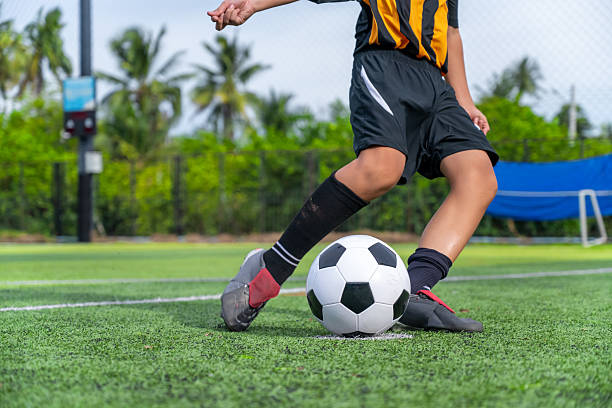
Your weaker foot is not just a less powerful version of your dominant foot. Players can have differences in balance, coordination, timing, foot speed and the way the hip, knee and ankle work together during a kick.
Research comparing preferred and non-preferred kicking legs has found higher ball velocities with the preferred leg, with differences linked partly to foot velocity and lower-limb coordination during the kicking movement.
That matters because smashing 100 shots with poor technique can give you 100 rehearsals of poor technique.
The better approach is progression.
Start with clean contact. Then add distance. Then add movement. Then add pressure.
That progression becomes especially useful for defenders, who need to stay composed when controlling or clearing difficult balls while an opponent is closing them down.
The ball should gradually stop feeling like something your weaker foot has been introduced to against its will.
The Equipment You Need
You can complete most of this programme alone with:
- One ball
- A wall, rebounder or sturdy passing surface
- Four to six cones or small objects
- A small goal, target or marked shooting area
- A phone for occasional technique checks
- 25 to 40 minutes per session
If you have no goal, two shoes, bottles or cones can create a target. The football has no opinion on the price of your equipment.
Before every session, spend five minutes warming up with light jogging, mobility work, dynamic movements and gentle ball touches. Avoid beginning with maximum-power shooting while your body is cold.
READ ALSO | 15-Minute At-Home Soccer Ball Mastery Routine
Days 1 to 7: Teach The Foot To Trust The Ball
The first week is deliberately simple because control comes before confidence.
Day 1: Baseline test
Record 20 short weak-foot passes against a wall from about five metres, counting how many reach your intended target cleanly.
Then attempt 10 weak-foot shots or firm passes towards a target from 8 to 10 metres and record your successful attempts.
Finish with 60 seconds of weak-foot toe taps and 60 seconds of sole rolls.
Write down the numbers. The point is not to impress yourself on Day 1. It is to give Day 30 something to argue with.
Day 2: Short passing
Stand five metres from a wall and complete five sets of 20 passes using only your weak foot.
Keep the ankle firm, approach the ball under control and aim for the same section of the wall rather than simply kicking it back.
After every pass, adjust your body so you are ready for the next ball.
Day 3: First touch
Pass the ball against the wall and receive it exclusively with your weak foot.
Complete 100 controlled touches, alternating between receiving across your body and cushioning the ball directly in front of you.
Your first touch should create your next action rather than merely stopping the ball.
Day 4: Inside and outside touches
Create a five-metre square and dribble around it using only your weak foot.
Complete five rounds with inside touches, five with outside touches and five using alternating surfaces.
Keep the ball close enough that you can change direction without taking a second business day to catch up with it.
Day 5: Passing while moving
Dribble slowly towards the wall, play a weak-foot pass, move sideways, receive the rebound and repeat.
Complete 75 repetitions.
The movement matters because football rarely gives you the luxury of standing square to the ball with perfect balance.
Day 6: Weak-foot finishing
Place the ball centrally, take one or two controlled touches and finish with the weak foot towards a marked target.
Complete 30 finishes at moderate power.
Prioritise accuracy over force. Research has found that fatigue can reduce both kicking velocity and accuracy, so this session should finish before technique starts falling apart.
Day 7: Recovery and review
Take a lighter day.
Spend 10 to 15 minutes juggling, gentle touches and easy weak-foot passing, then review your first-week numbers.
Notice where the biggest problems appear. Maybe receiving is uncomfortable while passing is improving, or perhaps your touch is fine until you have to shoot.
That weakness becomes part of Week 2.
Days 8 to 14: Add Movement
The second week turns the weaker foot from a stationary tool into a footballing tool.
Day 8: Receive and escape
Pass against a wall, receive with the weak foot and take your first touch diagonally away before passing again.
Complete 100 repetitions, changing the direction of your first touch every 10 to 15 repetitions.
Day 9: Two-touch passing
Complete 100 wall passes using a strict two-touch pattern: receive with the weak foot, pass with the weak foot.
For the final 30 repetitions, increase the distance slightly.
Day 10: Dribbling gates
Place two cones roughly one metre apart and create five gates.
Dribble through each gate using only your weak foot, then accelerate for three metres before slowing down.
Complete 10 circuits.
Day 11: Pull, push, pass
Receive from the wall, pull the ball across your body with the sole, push it forward with the inside of the weak foot and pass back.
Complete 60 repetitions.
This introduces different surfaces of the foot while keeping the exercise recognisably connected to football.
Day 12: First-touch finishing
Pass against the wall, allow the rebound to move slightly away from you and finish with your weak foot after one controlling touch.
Complete 30 attempts from each of three angles.
Day 13: Passing under fatigue
Complete five rounds of:
- 20 seconds quick dribbling
- 10 weak-foot passes
- 10-second recovery
Repeat five times.
The purpose is to make your weak foot work while your legs are no longer fresh.
Day 14: Test day
Repeat Day 1.
Use the same distance, ball, target and number of attempts.
Do not move the goalposts because your first score looks ugly. The comparison only works when the test stays consistent.
READ ALSO | 10 Wall-Ball Drills to Dramatically Improve First Touch and Passing Accuracy
Days 15 to 21: Make It More Football-like
This is where the training starts becoming less about isolated technique and more about actions that resemble a match.
Research on non-preferred-foot training has found that systematic technical work can increase use of the weaker foot during actual games and reduce functional asymmetry.
Day 15: One-touch passing
Start close to the wall and complete 50 one-touch passes with the weak foot.
Then move further away and complete another 50 using two touches when necessary.
Day 16: Directional receiving
Before each wall pass, decide where the next touch will go.
Receive left, right, forward and across your body rather than allowing the ball to dictate everything.
Day 17: Weak-foot turns
Use inside cuts, outside cuts, sole rolls and drag-backs to change direction.
Complete five minutes of continuous movement, rest for two minutes, then repeat.
Day 18: Moving finishing
Start five metres away, dribble diagonally and finish with the weak foot.
Complete 30 attempts, changing the starting angle every five shots.
Day 19: Passing through gates
Create three passing gates at different distances.
Pass through the nearest gate ten times, then the middle gate ten times and the furthest gate ten times.
Repeat the sequence three times.
Day 20: Weak-foot combination
Perform this sequence repeatedly:
Receive → first touch → dribble → change direction → pass → move → receive → finish.
Complete 15 full sequences.
This is deliberately more demanding because football does not separate every skill into neat little boxes.
Day 21: Recovery and video check
Take a lighter session and record 10 passes plus five shots.
Compare the footage with Day 1.
Look for balance, body position, contact point, follow-through and whether your first touch is giving you enough space to play the next action.
Video can help players pay attention to movement cues during non-dominant-foot kicking practice, although research on video self-modelling has produced mixed evidence rather than a guarantee of superior results.
Days 22 to 28: Add Pressure
The final training week is about making the weak foot useful when your brain has something else to worry about.
Day 22: Numbered targets
Give three targets different numbers.
Before each pass, call out or randomly select the target, then play it with your weak foot.
Complete 60 attempts.
Day 23: Weak-foot dribble race
Set up a five-cone course and complete six runs using only your weak foot.
Record your time, while still counting missed gates or loose touches.
Speed matters only when you can keep the ball under control.
Day 24: Random finishing
Place three targets around the goal.
Choose one randomly before each shot and finish with the weak foot.
Complete 30 attempts.
Day 25: Two-touch pressure
Give yourself a maximum of two touches after every wall rebound.
Complete 100 repetitions.
If your first touch is poor, reset rather than turning every repetition into a scramble.
Day 26: Weak-foot match circuit
Complete five rounds of:
Dribble → change direction → pass → receive → accelerate → finish.
Rest for 60 to 90 seconds between rounds.
Day 27: Your weakest skill
Return to the exercise that has improved least during the previous three weeks.
Give it 25 minutes.
This is where individualisation matters. A player whose weak-foot passing is already reliable has little reason to spend another half hour congratulating himself with five-metre passes.
Day 28: Full technical test
Repeat your Day 14 assessment.
Record your passing accuracy, first-touch quality, dribbling control and finishing accuracy.
Days 29 and 30: Prove it
Day 29: Pressure session
Build a 20-minute circuit containing every major action:
- 20 wall passes
- 20 directional receptions
- 10 dribbling gates
- 10 weak-foot passes through targets
- 10 finishes
- Repeat twice
Keep a score.
The goal is to make mistakes manageable rather than allowing one poor touch to derail the whole session.
Day 30: Final test
Repeat exactly the same baseline test from Day 1.
Compare:
Passing accuracy
First-touch control
Dribbling errors
Finishing accuracy
Time through your dribbling course
Then repeat five shots with your dominant foot and five with your weak foot.
Do not expect the two feet to become identical after 30 days. Research suggests that reducing asymmetry requires sustained practice, with one study involving young players using six months of non-preferred-foot technical training when examining changes during matches.
Thirty days gives you a foundation, not a certificate of completion.
Rules That Make 30 Days Work
The most important rule is simple: quality beats volume when technique starts collapsing.
Players can build plenty of useful repetition into their routine without relying on cones, ladders or other training equipment, especially when the focus is on clean touches and controlled technique.
Give the weak foot frequent exposure, while keeping the repetitions purposeful. A few hundred controlled touches can teach you more than a thousand rushed ones.
Use both feet in training rather than turning every session into a punishment for your weaker side. Research on bilateral practice supports training both limbs, with studies reporting improvements in technical performance and reduced lateral asymmetry.
Keep the ball close during dribbling, practise different surfaces of the foot, and gradually increase speed only after control becomes reliable.
Most importantly, carry the habit into normal football. If a pass can safely be played with your weak foot during a casual game, play it with your weak foot. If there is room to receive on that side, take it. Your training ground should teach the movement, while actual football teaches you when to use it.
The real breakthrough arrives when you stop thinking, I have to use my weak foot.
You receive the ball, see the space and use it.
That is when the awkward foot starts becoming a football foot.