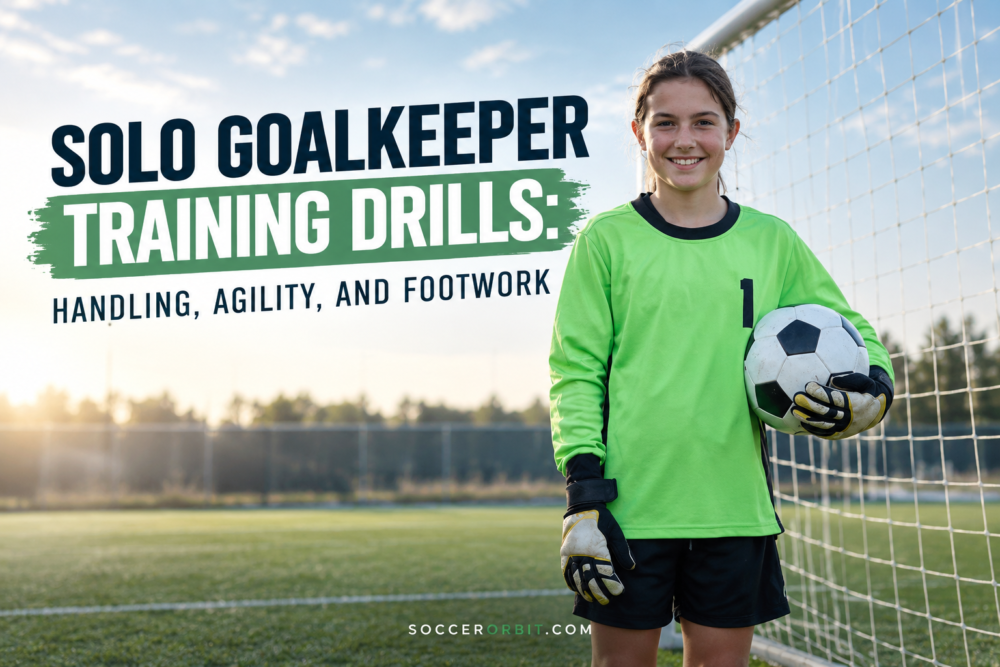
Goalkeeper training drills can look slightly strange from the outside. There you are, standing in a goal with a football, a few cones and nobody trying to score, which can resemble either serious training or a very committed argument with yourself.
Yet a surprising amount of goalkeeper development can happen without a shooter when the session is built around handling, movement, balance, reactions and clean technique.
Modern goalkeeper coaching places considerable emphasis on footwork and explosive movement, with FIFA’s recent goalkeeper training work repeatedly linking small, controlled steps with the ability to adjust position before catching, diving or dealing with balls in the air.
The absence of a striker can actually be useful. It gives the goalkeeper time to concentrate on the details that often disappear when the ball is travelling at frightening speed.
What You Need for a Solo Goalkeeper Session
You do not need an elaborate training ground. A football, six to eight cones, a wall or rebounder and a goal are enough for most home sessions, and players looking for a simple starting point can build a productive routine around basic ball-mastery work.
A stopwatch can help you control repetitions and rest periods.
The surface matters more than the equipment, particularly when diving or landing, so avoid concrete and uneven ground for exercises that involve going to the floor.
A simple 45 to 60-minute session can be divided into three sections:
- Handling: 15 to 20 minutes
- Footwork and agility: 15 to 20 minutes
- Movement with the ball: 10 to 15 minutes
The FA’s goalkeeper coaching material similarly treats handling, footwork, positioning and distribution as connected parts of goalkeeper development rather than isolated tricks.
1. Self-Toss Handling Drill
This is about as basic as goalkeeper training gets, which makes it useful. Before worrying about spectacular saves, a goalkeeper needs to become comfortable receiving the ball cleanly from different heights.
How to do it
- Stand with your feet approximately shoulder-width apart, knees slightly bent and your weight balanced towards the balls of your feet.
- Hold the ball around chest height and toss it approximately one metre above your head.
- Track the ball with your eyes rather than moving your head excessively.
- Catch it with both hands in front of your face or upper chest, depending on the height.
- Secure the ball against your body immediately after the catch.
- Repeat for 10 catches, then increase the height and repeat another 10 times.
- Finish with five catches while taking one small step forward, sideways or backwards before securing the ball.
FIFA’s goalkeeper coaching guidance stresses slightly bent knees, a stable upper body, balanced feet and hands working together when catching, with the ball contacted out in front of the face rather than allowed to crash into the body.
Progression: Toss the ball slightly to either side and move your feet before catching it, forcing yourself to combine movement with handling.
2. Wall Rebound Catching Drill
A wall can become a remarkably useful goalkeeper coach, provided you accept that it will never compliment your saves.
How to do it
- Stand 3 to 5 metres from a solid wall with the ball in your hands.
- Throw the ball firmly against the wall at chest height.
- As it rebounds, adjust your feet before catching it.
- Alternate between catching centrally and allowing the rebound to move slightly left or right.
- Increase the pace gradually rather than throwing as hard as possible from the first repetition.
- Complete three sets of 10 catches.
- For the final set, deliberately vary the height of your throw so the rebound arrives around your waist, chest and head.
The important part is the movement before the catch. FIFA’s catching work specifically combines lateral footwork with body orientation because a goalkeeper rarely receives every ball from a perfectly central position.
READ ALSO | How to Improve Your Weak Foot in Soccer: A 30-Day Solo Progression
3. Drop, Shuffle and Catch
This drill introduces a small element of chaos without requiring another person.
How to do it
- Place two cones approximately 2 metres apart.
- Start between them in your goalkeeper stance.
- Drop the ball in front of yourself.
- As it bounces, shuffle quickly to the left cone.
- Recover to the centre and repeat towards the right cone.
- On every third repetition, throw the ball slightly away from your body and move towards it before catching.
- Perform three sets of 30 to 40 seconds, resting for approximately 30 seconds between sets.
Keep the upper body controlled while the feet work underneath you. FIFA’s recent explosive-footwork guidance highlights strong footing, an upright posture and the ability to generate force from the ground during short goalkeeper movements.
The temptation here is to move the feet as quickly as possible. Resist it. Fast feet that leave you leaning backwards are rather like having a Ferrari with square wheels.
4. Four-Cone Goalkeeper Footwork Box
Goalkeepers spend plenty of time making small adjustments, and those adjustments rarely look dramatic on television because good positioning often prevents the dramatic moment from happening.
How to do it
- Create a square approximately 3 metres by 3 metres.
- Start in the centre.
- Shuffle to the left cone and return to the centre.
- Shuffle right and return.
- Move forward using short steps and retreat backwards under control.
- Repeat the sequence continuously for 30 seconds.
- Rest for 30 seconds and complete four rounds.
- In the final two rounds, hold a football at chest height while moving.
The objective is not to win a footwork race against yourself. Keep your chest facing forward, avoid crossing your feet during lateral movements and finish every movement balanced enough to perform a catch or save immediately.
FIFA training material repeatedly identifies coordinated small steps and stable footing as foundations for adjusting to different ball trajectories and saving actions.
5. Lateral Push-Off and Low Save Drill
A goalkeeper can practise the mechanics of getting down to the ball without needing somebody to fire shots at them.
How to do it
- Place a ball about 1.5 to 2 metres to your left.
- Start in your normal goalkeeper stance.
- Take a small step in the opposite direction first.
- Transfer your weight onto the inside leg.
- Push from that leg and move towards the ball.
- Get low and collect the ball securely.
- Return to your starting position and repeat on the other side.
- Complete five repetitions each way, then repeat for three sets.
FIFA’s low-diving guidance specifically describes the importance of using the inside foot to generate the push, transferring weight correctly and securing the ball with the lower hand supporting it while the upper hand helps control it.
For younger or less experienced goalkeepers, perform the movement slowly before introducing speed. Technique should arrive before theatrics.
6. Self-Toss High Ball Drill
High balls are difficult to practise alone because the goalkeeper normally needs another person to create the delivery, although a self-toss can still train the movement pattern.
How to do it
- Stand approximately 3 metres from the goal line.
- Hold the ball at chest height.
- Toss it high and slightly forward.
- Move underneath the ball using controlled steps.
- Bring the front knee upwards as you jump.
- Drive the back foot into the ground to generate lift.
- Raise both hands together and catch the ball at the highest comfortable point.
- Land with control and immediately secure possession.
- Complete 8 to 10 repetitions.
FIFA’s current high-ball coaching guidance emphasises judging the ball’s flight, coordinating the feet, using the back foot to generate power, and maintaining upper-body stability while the hands rise together.
The goal is not simply to jump high. It is to arrive underneath the ball with your body organised enough to catch it.
7. Reaction Wall Drill
This is where the wall starts earning its place in the squad.
How to do it
- Stand 2 to 3 metres from a wall.
- Throw the ball against the wall at different angles using both hands.
- Allow the rebound to arrive unpredictably to your left or right.
- Move your feet first, then make the catch.
- If the ball travels beyond comfortable catching range, use one hand to parry it safely away.
- Retrieve the ball quickly and repeat.
- Work for 20 seconds at high intensity, followed by 40 seconds of recovery.
- Complete five rounds.
The unpredictable element matters because elite goalkeeper research has identified a tension between traditional repetitive technical drills and training environments that force goalkeepers to adapt to changing situations.
That does not mean every drill needs to become chaotic. It means a goalkeeper should gradually move from rehearsing a movement to responding to a movement.
8. Footwork Into Distribution
Modern goalkeeping extends beyond the six-yard box, and FIFA describes the goalkeeper as an important participant in build-up play, with the ability to distribute accurately with both feet under varying levels of pressure.
How to do it
- Place two cones approximately 5 metres apart.
- Start between them with the ball at your feet.
- Shuffle left, receive the ball under your control and play a pass against a wall.
- Move right immediately after the pass.
- Receive the rebound with your opposite foot.
- Take your first touch away from the imagined pressure.
- Pass again using the other foot.
- Continue for 60 seconds.
- Rest for 30 seconds and complete four rounds.
This drill is especially useful because it connects goalkeeper movement with the first touch and passing decision that follows.
A keeper who can move beautifully without the ball and then miscontrol it under pressure has solved only half the problem.
READ ALSO | 10 Wall-Ball Drills to Dramatically Improve First Touch and Passing Accuracy
How to Build a 45-Minute Solo Goalkeeper Session
A practical session could look like this:
| Phase | Drill | Time |
|---|---|---|
| Warm-up | Mobility, skips, light footwork | 5 min |
| Handling | Self-toss catches | 7 min |
| Handling | Wall rebound catches | 7 min |
| Footwork | Four-cone box | 6 min |
| Agility | Drop, shuffle and catch | 6 min |
| Saving movement | Low push-off drill | 5 min |
| High balls | Self-toss high catches | 5 min |
| Distribution | Footwork into passing | 4 min |
Keep the intensity controlled during the technical exercises and increase it during the movement sections.
Liverpool’s former goalkeeper coach John Achterberg has described training that begins with footwork and movement before progressing towards speed, reactions and power, which reflects the importance of preparing the movement before asking the goalkeeper to execute at full intensity.
What Solo Training Cannot Reproduce
There is a limit to what one goalkeeper, one football and a wall can recreate.
A solo session cannot properly reproduce a striker’s body shape, deflections, screened shots, crosses under pressure, rebounds from unpredictable saves or the decision-making involved in a crowded penalty area. FIFA’s own training research has highlighted the value of practices that progress from controlled technical work towards situations requiring adaptation and decision-making.
That makes solo training a supplement rather than a replacement for goalkeeper coaching and realistic team practices. For players who want to make the most of individual sessions, learning how to structure effective soccer practice alone without relying on cones or other equipment can provide a useful foundation.
The smartest approach is to use solo work for repetition and technical ownership, then use coached sessions to test whether those techniques survive when the game becomes messy.