Recreational (REC) vs travel soccer can feel like a simple choice when a child is eight or nine, but the differences between recreational, select, academy, and higher-level club soccer become much clearer once training, competition, cost, travel, coaching, and family commitment enter the picture.
For parents of U8 to U12 players, the most important thing is finding the level that fits the child today rather than choosing the most advanced label available. A player can develop beautifully in recreational soccer, while another child may benefit from a more structured academy environment, and neither choice needs to define where that player eventually ends up.
U.S. Soccer currently describes the youth scene broadly across recreational, competitive, pre-professional, and professional levels, with recreational soccer focused on foundational understanding, leisure, and social participation, while competitive soccer places greater emphasis on competition and development toward higher levels.
The terminology can still be confusing because clubs use words such as academy, select, premier, competitive, club, and travel differently from one organization to another, which means parents should look beyond the name and study what the program actually provides.
What Is the Difference Between Recreational Soccer and Club Soccer?

The difference between recreational soccer and club soccer usually comes down to how teams are formed, how often players train, how competitive the games are, and how much time and money families are expected to commit throughout the year.
Recreational soccer, commonly called rec soccer, is generally designed to make the sport accessible to children across a wide range of abilities, with local games, fewer training sessions, lower fees, and an environment where enjoyment and participation remain central.
Club soccer usually operates at a more competitive level, with players commonly evaluated or selected for teams, professional or licensed coaching, more frequent practices, stronger competition, tournaments, and considerably greater family involvement.
That difference matters because a U9 player who loves soccer but enjoys several other sports may thrive in rec, while a U10 player who constantly asks for additional training and wants stronger competition may be ready for a more demanding environment.
There is also no universal rule that says every recreational player must eventually move into club soccer, because recreational soccer can remain a valuable place for children who want the sport as part of a balanced childhood rather than as their primary athletic commitment.
Recreational Soccer
Recreational soccer is usually the broadest entry point into organized youth soccer, allowing children to register without the same level of selection pressure that exists in competitive programs.
Many recreational programs operate around local communities, schools, nonprofit organizations, or soccer associations, with volunteer parents frequently serving as coaches and teams generally playing against nearby groups.
The structure varies considerably by organization, but recreational programs commonly involve one or two practices each week, local league games, shorter seasons, and substantially less travel than competitive club programs.
For U8 to U12 players, that environment can provide plenty of opportunities to develop basic ball control, passing, dribbling, receiving, shooting, positioning, and an understanding of how the game works.
The strongest advantages of recreational soccer include:
- Lower overall financial commitment compared with most travel programs.
- Less driving and fewer overnight tournament commitments for families.
- More flexibility for children who participate in other sports or activities.
- A wider range of playing ability within the same community.
- A lower-pressure environment where children can build confidence.
- More opportunities for children to continue playing simply because they enjoy soccer.
Parents sometimes underestimate rec soccer because the games may look less organized than competitive matches, but a young player who receives regular touches, enjoys training, and develops a lasting love for the sport can build an excellent foundation there.
What Does Select Soccer Mean?
Select soccer meaning can vary from club to club, but the term generally describes a competitive program where players are evaluated and placed onto teams according to ability, readiness, development, and commitment.
Select soccer is commonly used interchangeably with competitive or travel soccer, although individual clubs may use these labels differently and may offer several competitive levels within the same organization.
The biggest change from recreational soccer is usually the expectation surrounding the player and family, because practices become more structured, competition becomes stronger, attendance matters more, and teams may travel outside the immediate community for league matches or tournaments.
A normal select environment may include two or three weekly training sessions, weekend games, tournaments, professional coaching, player evaluations, and a roster created through tryouts rather than open registration.
For a U8 to U12 player, select soccer can be a useful middle ground when recreational soccer no longer provides enough challenge but a highly demanding elite environment would still be too much.
Academy Soccer Sits Between the Levels

Academy soccer can be particularly confusing because clubs use the word differently, with some organizations treating academy as a developmental program for younger children while others use it as a label for an advanced competitive pathway.
At many clubs, academy programs are aimed at younger players, often around U6 through U10 or U12, and are designed to introduce more structured coaching before children enter older competitive teams. One club, for example, describes its academy as a U6 to U10 developmental stage leading toward club soccer, while another organization places academy and select together within its competitive structure.
That means parents should never assume that the word academy automatically means elite soccer, because the actual training model, league level, coaching staff, roster process, and competition schedule matter much more than the label.
A strong academy environment for a U8 or U9 player should usually give the child more deliberate technical development while preserving enough freedom for experimentation, creativity, and enjoyment.
For younger players, this can be especially useful because they are still building the technical foundation that will influence how comfortable they feel with the ball several years later.
Rec vs Travel Soccer: The Biggest Differences
The easiest way to compare the two levels is to look at what changes in everyday soccer family life rather than focusing only on the quality of the games.
| Area | Recreational Soccer | Select / Travel Soccer | Academy Soccer |
|---|---|---|---|
| Team formation | Usually open registration | Tryouts or evaluations | Varies by club |
| Competition | Local and mixed ability | More competitive | Development-focused to competitive |
| Training | Usually 1 to 2 sessions weekly | Often 2 to 3 or more | Usually structured and technical |
| Travel | Limited | Regular regional travel | Varies considerably |
| Tournaments | Limited or occasional | Common | Depends on program |
| Coaching | Often volunteer-based | Usually professional or licensed | Usually specialized coaching |
| Cost | Generally lower | Much higher | Varies widely |
| Commitment | Flexible | Considerable | Moderate to considerable |
| Pressure | Usually lower | Higher | Depends on environment |
| Best fit | Fun, flexibility, foundation | Competitive development | Younger players seeking more structure |
The biggest practical jump usually comes from time rather than soccer ability, because competitive teams can add multiple practices, weekend matches, tournaments, travel days, and offseason activities to a child’s weekly calendar.
That can work very well for a family that enjoys the routine, but it can become difficult when the child has other sports, school responsibilities, family commitments, or simply needs more downtime.
When to Move From Rec to Competitive Soccer
The question of when to move from rec to competitive soccer should be based less on age and more on the child’s interest, readiness, personality, and response to the current environment.
A child may be ready when several signs appear together, particularly when they are consistently engaged during training, actively want more soccer, respond well to coaching, and enjoy playing against stronger opponents.
Useful signs include:
- The child regularly asks for additional soccer opportunities outside normal practices.
- Recreational games have become noticeably easy for the player.
- The child remains motivated when opponents provide more resistance.
- The player enjoys learning new skills rather than only scoring goals.
- The child can handle constructive coaching without losing confidence.
- Missing a practice feels disappointing because the player genuinely wants to attend.
- The family can comfortably handle the expected schedule and financial commitment.
- The child understands that competitive soccer can involve less playing time and stronger competition.
A player does not need to dominate recreational soccer before trying out for a competitive team, because development depends on technical ability, decision-making, athletic qualities, coachability, and the player’s potential to improve within the environment.
Parents should also remember that moving up does not guarantee faster development, because a poorly run competitive program can provide less useful training than a well-coached recreational or academy environment.
Training Matters More Than the Badge on the Jersey
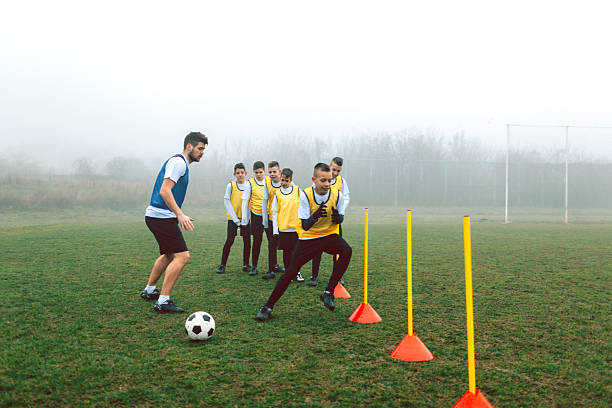
For U8 to U12 players, parents should pay close attention to what happens during training rather than judging a program primarily by its league name.
A strong young-player session should involve plenty of touches, small-sided activities, decision-making, repetition, movement, and opportunities for players to solve problems rather than spending most of the session standing in lines.
The coach’s behavior also matters enormously, because young players learn differently when the coach creates an environment where mistakes are treated as part of learning and players are encouraged to make decisions.
A highly competitive team with poor training habits can leave a child frustrated, while a less prestigious academy with excellent coaching may give that same player a much stronger foundation.
This is one reason parents should attend a training session when possible, speak with the coach, observe how players interact with staff, and ask how the club handles player development across an entire season.
The Cost Difference Can Be Large
Money becomes one of the clearest differences between rec and travel soccer, because competitive programs can involve coaching fees, registration, uniforms, tournaments, facilities, league fees, travel, hotels, meals, and additional training.
Current 2026 examples show how widely the cost can vary, with one travel organization listing U8 fees around $1,725 and U9 through U12 fees above $2,300 before some additional expenses, while another organization lists competitive travel fees ranging from roughly $1,900 to nearly $4,000 depending on team and age group.
Travel expenses can become particularly important because tournament weekends may require gasoline, hotels, meals, parking, and sometimes flights, with the total family cost depending heavily on how far the team travels and how many tournaments it enters.
For a more detailed breakdown of registration, uniforms, tournament expenses, hotels, transportation, and other costs, parents can use this guide on How Much Does Travel Soccer Cost? before committing to a travel program.
The important point is that the advertised club fee rarely tells the entire financial story, because two clubs charging similar tuition can produce very different total family costs once tournament travel and optional training are added.
Travel Soccer Also Changes the Family Schedule
The financial commitment gets most of the attention, but the schedule can be even more important for families with younger children.
A competitive U9 or U10 team might train several times during the week and play weekend matches, while tournaments can turn a single Saturday game into an entire weekend commitment involving multiple matches and travel.
Some current travel programs list two regular training sessions plus additional age-group training for U8 to U12 players, along with several tournaments and winter programming during the year.
That structure can be fantastic for a child who loves soccer, but parents should look at the entire calendar before accepting a roster position, especially when the child also plays basketball, baseball, swimming, or another school sport.
Academy, Select, and Travel Are Not Always Separate Steps
One of the biggest misconceptions in youth soccer is assuming there is one national ladder where every child moves from rec to academy, then select, then travel, then elite soccer in exactly that order.
The American youth system is much more varied, with clubs creating their own developmental structures and using different labels for similar levels, while national platforms such as ECNL and MLS NEXT have their own competition structures and eligibility rules.
For example, MLS NEXT introduced its Academy Division in the 2025-26 season, creating a second division alongside the Allstate Homegrown Division, and the platform expanded to 318 clubs and more than 53,000 players across both divisions for 2026-27.
For 2026-27, MLS NEXT is also using different age-group structures between those divisions, with the Allstate Homegrown Division continuing with birth-year registration while the Academy Division moves to school-year registration.
This makes it especially important for parents to understand the actual program rather than assuming that a particular word on the club website tells them where the team sits nationally.
Age Groups Are Changing in 2026-27
Age-group registration deserves particular attention for families entering the U8 to U12 years because the U.S. youth soccer landscape is changing for the 2026-27 season.
U.S. Soccer has given its member organizations flexibility to determine the registration cycle used by their leagues and competitions, including birth year, August-to-July seasonal year, or September-to-August seasonal year structures.
US Youth Soccer, US Club Soccer, and AYSO announced a move to an August 1 through July 31 seasonal-year formation cycle beginning with the 2026-27 season, although U.S. Soccer’s broader policy means parents still need to confirm the specific structure used by their child’s league or club.
Parents who are trying to understand the practical effect of birth-year and school-year registration should particularly understand it before comparing teams that use different registration structures.
What Happens After Academy or Select Soccer?
For children who continue developing, competitive soccer can eventually lead toward increasingly demanding regional and national platforms, although there is no guarantee that a young player will follow one specific route.
The ECNL, for example, operates ECNL, ECNL Regional League, and Pre-ECNL environments, with the organization continuing to expand its pathway for younger players and competitive clubs during the 2026-27 season.
The ECNL’s 2026-27 schedule includes numerous national events, while both ECNL and ECNL Regional League provide opportunities for players to compete at increasingly advanced levels as they get older.
Families comparing elite pathways can explore which is better for their kids between MLS NEXT or ECNL
For families considering MLS NEXT specifically, the difference between an MLS-connected youth pathway and an independent affiliate structure also deserves careful attention, which is covered in MLS NEXT Homegrown vs. MLS NEXT Affiliate
The Best Choice for a U8 to U12 Player
For most parents, the right decision comes down to matching the soccer environment with the child rather than chasing the strongest-sounding team name in the area.
Recreational soccer is often the right choice when a child mainly wants to play with friends, enjoys other activities, needs a flexible schedule, or is still discovering whether soccer will become a serious interest.
Academy soccer can make sense when a younger player wants more technical instruction, enjoys training, and would benefit from stronger coaching without immediately entering the full demands of high-level travel soccer.
Select or travel soccer becomes more attractive when the player actively wants stronger competition, is comfortable with structured training, responds well to coaching, and the family is prepared for the additional time, travel, and financial responsibility.
The best program should give the child room to improve while still leaving enough enjoyment in the game to keep them coming back year after year.
A Simple Way to Choose
Before accepting a place on any team, parents should look beyond the logo, league name, and promises about future opportunities, because the day-to-day environment will have a much greater effect on a young player’s experience.
A useful checklist includes:
- Watch at least one training session before committing.
- Ask how many practices and tournaments are expected each season.
- Find out exactly what the advertised fee covers.
- Ask about uniforms, tournament fees, travel, hotels, and winter training.
- Learn how playing time is handled at the child’s age.
- Ask how coaches evaluate player development.
- Find out whether the club has multiple teams at the same age group.
- Understand the registration cycle used for the 2026-27 season.
- Speak with parents whose children already play in the program.
- Pay attention to whether your child actually enjoys the environment.
For U8 to U12 players, development should remain the center of the decision, because children are still building technical ability, confidence, game understanding, physical coordination, and the habits that will shape their relationship with soccer for years.