
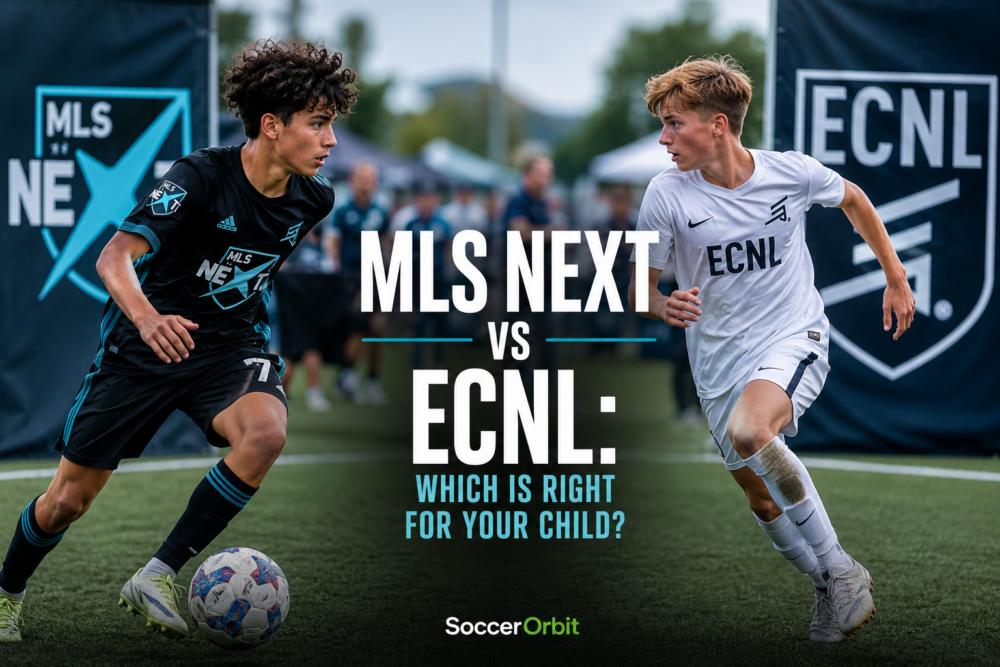
MLS NEXT vs. ECNL has become one of the biggest decisions in American youth soccer, particularly for parents whose children are approaching the age when elite club soccer starts to become a serious pathway toward college, professional academies and higher-level competition.
The choice looks simple from the outside because both leagues occupy the upper end of the American youth game, but the reality becomes much more complicated once you look at what each platform is trying to achieve, how often players compete, where college coaches scout, how professional opportunities are created, what high school soccer means to the family and how much the entire experience will cost.
The biggest mistake is treating the league badge as the decision.
A strong MLS NEXT club can be a better environment than a weak ECNL club, just as an excellent ECNL program can give a player more meaningful development and recruiting exposure than an MLS NEXT team where the player spends most of the season struggling for minutes.
That makes the decision less about finding a universal winner and more about understanding the two systems, then measuring them against the player standing in front of you.
Two Elite Pathways, Two Different Ideas of Development
MLS NEXT and ECNL both exist to raise the standard of youth soccer, but their histories give them different identities within the American game.
MLS NEXT emerged in 2020 after the U.S. Soccer Development Academy shut down, with Major League Soccer creating a national platform designed around elite player development and a closer connection to the professional game.
ECNL arrived much earlier, launching in 2009 and gradually developing into one of the country’s largest elite club platforms for both boys and girls, with college recruitment becoming one of the central parts of its identity.
That difference remains visible today.
MLS NEXT has a professional pathway built into its structure, particularly through its Allstate Homegrown Division, while ECNL has developed an enormous national competition and showcase network that has become deeply familiar to college coaches.
Neither philosophy makes one league automatically better.
They simply create different opportunities for players with different ambitions.
The important part for parents is understanding exactly where their child fits inside that structure, because an ambitious U13 player with professional potential may need something very different from a U17 player whose priority is finding the right college.
What Is MLS NEXT Designed to Produce?
MLS NEXT has become much larger and more complicated since its original launch, and the old description of it as one elite boys league no longer accurately captures the structure families are entering in 2026.
For the 2025-26 season, MLS NEXT introduced the Academy Division alongside the top-level Allstate Homegrown Division, and the expansion more than doubled participation to 273 clubs, 2,189 teams and more than 43,000 players across the two divisions.
The difference matters because the two divisions serve different purposes within the broader MLS NEXT ecosystem.
The Allstate Homegrown Division remains the top level, with 152 clubs for the 2025-26 season, including all MLS academies and 123 MLS NEXT Elite Academies, and it operates around a 10-month, pro-style calendar designed to prepare players for higher levels of the game.
The Academy Division was created to broaden access while maintaining elite standards, using a more regionally focused schedule that works around high school calendars and allows its players to participate in high school soccer.
That changes the conversation considerably.
A parent comparing an MLS NEXT Academy Division offer with an ECNL offer is making a different decision from a parent whose child has been invited into an MLS academy environment within the Allstate Homegrown Division.
The words MLS NEXT may appear on both offers, but the developmental experience can be very different.
MLS NEXT Has Changed. Does That Change the Decision?
It should at least change the way parents investigate an offer.
MLS NEXT announced another expansion ahead of the 2026-27 season, bringing the platform to 318 clubs and more than 53,000 players across its two divisions, with the organization also adding new clubs and conferences.
Five clubs are moving from the Academy Division into the Allstate Homegrown Division for 2026-27, which shows that the newer structure is not simply a second competition sitting permanently underneath the original platform.
There is movement between levels.
There is also a huge age-group change coming into the 2026-27 season, with the Allstate Homegrown Division continuing to use birth-year registration while the Academy Division moves to school-year registration, a change MLS NEXT says is intended to better align the Academy Division with the wider American youth soccer landscape.
For soccer parents, these details may sound administrative, but they can affect who a player competes against, how the season fits around school and what the transition between levels looks like.
The old version of MLS NEXT was easier to describe.
The new version needs to be examined club by club and division by division.
Where ECNL Has Built Its Recruiting Advantage
ECNL’s strongest suit is not just that it has good teams.
It has built a huge recruiting ecosystem around those teams.
The league’s national events bring large numbers of elite players together in locations where college coaches can evaluate several teams and hundreds of prospects over a concentrated period, which makes the platform particularly attractive to families thinking seriously about college soccer.
The 2026-27 ECNL calendar includes 13 recruitable ECNL events, while the ECNL Regional League has 12 recruitable events, with the league reporting that top ECNL Girls showcases averaged more than 1,000 scouts each during the previous season.
Those numbers explain why ECNL has become so prominent in the college recruiting conversation.
The Boys side has also developed a substantial recruiting presence, with ECNL reporting more than 1,670 college or professional commitments from its 2024 graduating class and multiple boys showcases drawing more than 500 college scouts during the 2024-25 season.
That does not make ECNL a college scholarship factory.
College coaches are still evaluating players rather than collecting league badges.
A midfielder who cannot cope with the speed of play will not become a Division I recruit because the shirt says ECNL, while a technically outstanding player in a strong MLS NEXT environment can still attract serious college interest.
The difference is that ECNL has constructed an environment where the opportunity to be seen is deliberately built into the competition calendar.
ECNL or MLS NEXT? Learn about the key differences before choosing a league for your child.
Which League Offers the Better College Recruiting Pathway?
For a player whose primary objective is college soccer, ECNL has a particularly strong case because the league has spent years refining the relationship between elite club competition and college scouting.
Its 2026-27 schedule continues that strategy with dozens of national and regional events, while the league itself describes the events as opportunities to put players in front of college and professional scouts throughout the season.
MLS NEXT should not be dismissed, however, because its own national events create substantial scouting opportunities.
The 2025 MLS NEXT Fest alone brought more than 1,000 teams from at least 200 clubs together in Arizona, with hundreds of professional, national-team and college scouts evaluating players across more than 1,800 matches.
That is an enormous scouting environment.
The difference is philosophical.
College recruitment is one of the defining strengths of the ECNL model, while MLS NEXT places college recruitment alongside a professional pathway that can lead toward MLS academies and MLS NEXT Pro.
For a player who is clearly targeting college soccer, ECNL may offer the more established recruiting environment.
For a player with genuine professional potential, the MLS NEXT structure can offer opportunities that college recruiting alone cannot provide.
Professional Soccer Changes the MLS NEXT Equation
This is where MLS NEXT becomes difficult to compare directly with ECNL.
The Allstate Homegrown Division is explicitly connected to the MLS Player Pathway, and every MLS academy competes within that division alongside MLS NEXT Elite Academies.
For a player already being identified by an MLS academy, that connection can be enormously valuable because the people evaluating the player are operating inside the same professional ecosystem that the player ultimately hopes to enter.
There is no guarantee attached to that pathway.
MLS NEXT remains youth soccer, and professional contracts are reserved for a tiny percentage of players who reach an exceptional level.
Still, the pathway is structurally different from a traditional club-to-college route.
A player can develop through the academy, attract attention from professional staff, progress toward MLS NEXT Pro and potentially reach an MLS first team without making college soccer the central bridge between youth and professional football.
That possibility changes the calculation for families whose child has genuine professional aspirations.
But there is another important caveat.
Not every MLS NEXT club is an MLS academy.
The Homegrown Division includes MLS academies and non-MLS MLS NEXT Elite Academies, meaning parents need to know exactly what professional access their child’s club actually provides rather than assuming the MLS name on the competition guarantees direct contact with a professional organization.
The Club Matters More Than the League
This is where the conversation should become much more local.
National league rankings are useful, but youth development happens at training sessions, not inside a spreadsheet.
The quality of the head coach, the level of the teammates, the training environment, the club’s player pathway and the amount of meaningful playing time can shape a young player’s development far more than the name of the competition.
A child joining a prestigious MLS NEXT team but spending most weekends on the bench may not be in a better developmental position than a player starting regularly for a strong ECNL club.
The same principle works in reverse.
A player who has outgrown their current ECNL environment may need the intensity of an elite MLS NEXT program to continue progressing.
Parents should therefore investigate the specific team rather than comparing the leagues in isolation.
The questions should include:
- Who coaches this age group?
- Where have this coach’s previous players gone?
- How many players move from the second team into the top team?
- Does the club develop players internally or constantly recruit replacements?
- How many players from this age group eventually reach college soccer?
- How many reach professional academies?
- Where will my child sit on the depth chart?
- How much individual development work does the club provide?
The answers tell you much more than the badge.
How Much Does Playing Time Matter?
At younger ages, playing time can be particularly important because players need thousands of decisions under pressure before the game begins to slow down for them.
They need touches.
They need responsibility.
They need to lose the ball, recover, make another decision and experience what happens when the choice works or fails.
A player who spends an entire season watching from the sideline may train against excellent opponents, but they are receiving fewer opportunities to apply what they learn.
That does not mean parents should always choose the easiest path.
A player needs to be challenged, and sometimes sitting behind a better player for a period can force the development of qualities that would never emerge in a comfortable environment.
The key is whether the player has a realistic route toward more responsibility.
A good coach should be able to explain what the player needs to improve, where they currently stand and what progress would look like over the next six months.
Vague promises about “development” should never be enough.
The Coaching Question Parents Often Miss
The coach may be the single most important variable in the decision, yet parents often spend more time comparing league reputations than examining coaching quality.
The best youth coaches understand that development involves more than winning matches, because they have to teach players how to see the game, make decisions, manage mistakes and eventually solve problems without waiting for instructions from the sideline.
Parents should watch a training session when possible.
Look at how much time the players spend actually working with the ball.
Watch what happens after mistakes.
Listen to whether coaches explain decisions or simply shout instructions.
Pay attention to whether the strongest players are challenged or protected.
A club can have an impressive national reputation and still provide an ordinary training environment.
Another club can be less fashionable while producing technically and tactically excellent players because the coaching is better.
The league gets the headline.
The coach shapes the player.
High School Soccer and the Lifestyle Question
High school soccer remains an important part of the decision for many American soccer families because the experience offers something beyond the technical and tactical side of club football.
Players represent their school, play with classmates, compete in front of friends and become part of a community that is separate from their club environment.
MLS NEXT historically created significant restrictions around school soccer for players in its top pathway, but the Academy Division has changed that picture by building its regional calendar around high school schedules and explicitly allowing its players to participate in high school soccer.
The Allstate Homegrown Division remains more closely tied to the professional development model, with its own player rules and high school provisions.
That means parents need to establish exactly which division their child is joining before assuming that an MLS NEXT offer either permits or prevents high school participation.
ECNL’s broader club structure can offer greater flexibility for families who want both elite club soccer and the high school experience, although the specific club schedule still needs to be checked before making the decision.
What Does Elite Youth Soccer Cost?
The cost of elite youth soccer cannot be reduced to the registration fee on the club’s website.
Travel can become the largest expense once a family starts attending national showcases, especially when flights, hotels, meals, rental cars and missed work are added to the annual budget.
Parents should calculate the entire season rather than comparing the headline club fee.
That means looking at:
- Tuition and registration
- Uniforms and training equipment
- Tournament fees
- Flights and long-distance travel
- Hotels
- Meals
- Local transportation
- Private training
- Strength and conditioning
- Showcase expenses
- Recruiting services or video costs
The financial difference between two clubs can therefore be much smaller or much larger than it first appears.
MLS NEXT also contains an important variable because professional academy environments can operate differently from independent clubs, while ECNL clubs have their own individual fee structures and financial-assistance policies.
There is no reliable single national price that should be presented as the cost of either league.
The sensible approach is to ask the club for the full expected annual cost, including travel, before comparing offers.
Does a Bigger Showcase Schedule Mean Better Exposure?
Not automatically.
Exposure only has value when the player is ready for the level of attention they are receiving.
A college coach may watch a player for ten minutes and decide that the technical level, speed of thought or athletic profile does not fit the program.
Another player may receive only a short viewing window but make enough intelligent decisions to earn a second look.
That is why recruiting should begin before the showcase.
Players need appropriate film, accurate academic information, a clear playing profile and a sensible list of colleges that actually fit their ability and goals.
ECNL’s event structure can create enormous visibility, while MLS NEXT’s national events can do the same, but neither platform removes the responsibility from the player.
The showcase opens the door.
Performance determines whether anyone walks through it.
Choosing the Right Environment at U13
The U13 stage can feel like a major crossroads because families are beginning to encounter more serious national competition and increasingly sophisticated club structures, but it is still far too early to treat one decision as a permanent verdict on a child’s future.
A player who is dominant at 12 may struggle at 14 when the physical and tactical demands change.
Another player who develops slowly may suddenly make a major jump between 14 and 16.
That is why parents should avoid making an enormous financial or lifestyle commitment simply because somebody has predicted that their child is destined for professional soccer.
At U13, the priority should be finding an environment where the player loves training, receives excellent coaching, competes against players who stretch their ability and has enough responsibility to make mistakes and learn from them.
The pathway can change later.
Good clubs understand that.
MLS NEXT vs. ECNL: Where Each League Has the Edge
MLS NEXT has the stronger hold when professional development is central to the decision, particularly for boys who have access to a MLS academy environment and are capable of handling the intensity and demands of the Homegrown pathway.
ECNL has the stronger hold when college recruitment and broad showcase exposure are the primary objectives, particularly for soccer families who also value flexibility around high school soccer and want access to a large national club network.
MLS NEXT Academy Division can be particularly attractive for families seeking elite competition without giving up high school soccer, because the newer structure was specifically built around regional competition and school calendars.
ECNL can also provide a broader developmental ladder, with the Regional League feeding into the national ECNL competition through performance-based promotion, and the 2026-27 season bringing ECNL Boys to more than 170 clubs across 15 conferences while ECNL Girls remains at 129 clubs across 10 conferences.
Those are meaningful differences.
They still do not answer the most important question.
So, Which League Is Right for My Child?
The right answer depends on the player, the club and the life surrounding the soccer.
For a player targeting college soccer, ECNL’s recruiting infrastructure makes it one of the strongest environments available in the United States.
For a boy with serious professional ambitions and access to a high-quality MLS academy, MLS NEXT can provide a more direct connection to the professional pathway.
For a player who values high school soccer, the specific MLS NEXT division and player designation become critical.
For a player who needs confidence, responsibility and regular minutes, the strongest offer may come from the club where the child has a genuine role rather than the program with the most impressive reputation.
And for the family, the right choice has to be financially and logistically sustainable because a development plan that exhausts the household by November will not look particularly clever by May.
The smartest parents therefore look beyond the league name.
They study the coach.
They study the team.
They study the player pathway.
They calculate the real cost.
They ask where similar players have gone.
Most importantly, they ask whether their child will actually become a better soccer player there.
That is the part that matters when the excitement of the tryout disappears and the long season begins.
MLS NEXT and ECNL can both open important doors in American soccer, but the league itself never becomes the player.
The environment does the developing, the player does the work, and the right pathway is the one that gives that particular child the best chance to keep improving.