
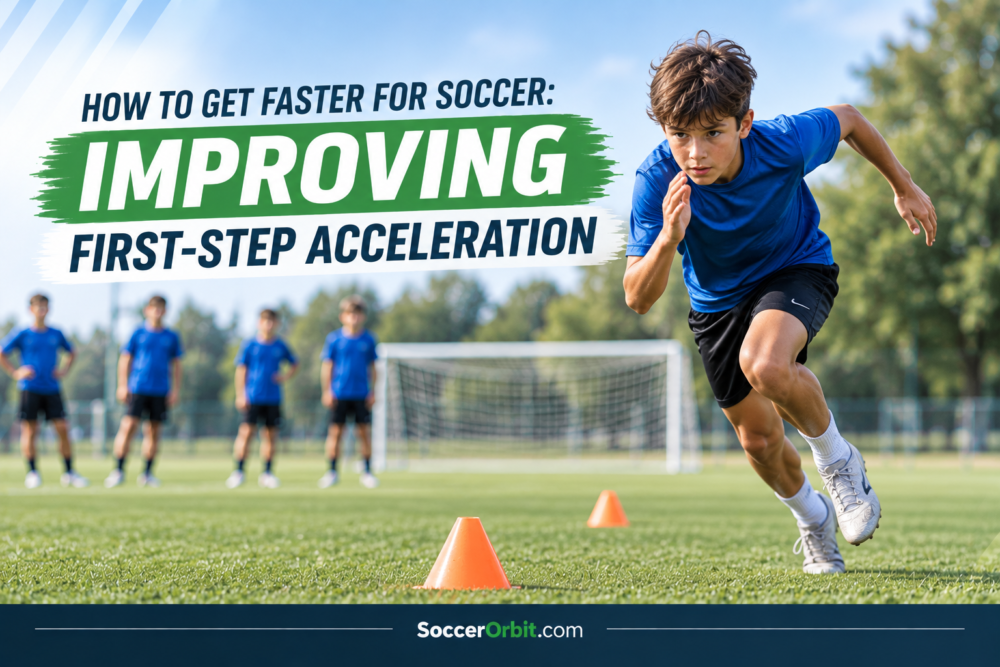
A defender takes one heavy touch, a midfielder spots a loose ball, or a striker sees half a yard of space behind the defensive line, and suddenly the next three steps matter more than the previous thirty minutes of running.
Learning how to get faster for soccer starts with improving those first few explosive movements, because the ability to accelerate over five or ten yards often decides who reaches the ball first.
Soccer speed has a slightly different personality from track speed, where athletes have time to build momentum over a longer distance.
On a football pitch, players are constantly starting from standing positions, jogging, turning, recovering or reacting to an opponent, which means their ability to produce force quickly can be more useful than their maximum sprint speed.
The good news is that first-step acceleration can be trained. It requires a combination of sprint technique, lower-body strength, explosive power, coordination and properly structured practice, rather than endless running around cones and hoping the legs eventually get the message.
The aim is simple: produce more force against the ground, direct it in the right direction and reach useful speed in fewer steps.
Why First-Step Acceleration Matters in Soccer

First-step acceleration describes how quickly a player can begin moving and build speed from a stationary or relatively slow position. It is particularly valuable during the opening five to ten metres, when players are trying to win possession, escape pressure, close down an opponent or attack space.
Consider a winger receiving the ball with a full-back standing two metres away.
The winger rarely needs to sprint 40 metres immediately. A sharp push off the ground, followed by two or three powerful steps, might create enough separation to deliver a cross or drive towards goal.
When the defender gets close enough to make that first burst difficult, the winger also needs to use their body to protect possession and create room to move away from pressure.
This also explains why a player who looks average in a 100-metre sprint can still be devastating over the first few metres.
What Makes a Soccer Player Faster?
Acceleration depends on how effectively the body produces and directs force into the ground, particularly during the early steps when horizontal propulsion is essential.
Three physical qualities deserve attention:
- Strength: Strong glutes, hamstrings, quadriceps and calves help players generate the force required to push away from the ground.
- Explosive power: The ability to produce force quickly allows a player to turn muscular strength into rapid movement.
- Sprint mechanics: Body position, arm action, foot placement and coordination determine how effectively that force moves the player forward.
These qualities work together, which is why practising sprints alone may leave some players with room for improvement, particularly when their strength and power development have received little attention.
How to Improve Your First-Step Speed
The first few steps of a sprint require a different body position from the upright running posture players use once they have built momentum, so learning to accelerate properly should begin with understanding how the body moves.
1. Develop a Forward-Leaning Starting Position
A common mistake among young footballers is trying to stand upright immediately after starting a sprint, which can reduce their ability to push backwards against the ground and drive themselves forwards.
During acceleration, the body should lean forward naturally from the ankles, with the hips, shoulders and head aligned rather than bending excessively at the waist.
Focus on these coaching points:
- Keep your eyes directed towards the ground a few metres ahead.
- Lean forward slightly while maintaining a firm, stable core.
- Push the ground backwards with each step.
- Drive your arms forcefully in coordination with your legs.
- Allow your steps to lengthen gradually as your speed increases.
The first steps should feel powerful and controlled, with the player gradually rising into a more upright running position instead of trying to reach maximum stride length immediately.
2. Strengthen Your Glutes, Hamstrings and Calves
A player cannot consistently produce explosive acceleration without developing the muscles responsible for driving the body forward, particularly the glutes, hamstrings, quadriceps and calf muscles.
Strength training provides the foundation for producing greater force, while sprinting teaches the body how to apply that force at the right time.
Useful exercises include:
- Squats: Develop lower-body strength and improve the ability to produce force through the hips and knees.
- Reverse lunges: Build single-leg strength and stability, which are particularly useful because sprinting involves alternating support from each leg.
- Romanian deadlifts: Strengthen the hamstrings and glutes through the hip-extension movement.
- Calf raises: Develop the lower-leg muscles involved in ankle stiffness and force transfer during ground contact.
For beginners, bodyweight exercises and light resistance are suitable starting points before gradually increasing the difficulty under qualified supervision.
3. Train Explosive Power With Plyometrics
Plyometric training involves rapid muscular actions that help players produce force quickly, making it particularly useful when developing the explosive movements required during acceleration.
However, acceleration becomes much more effective when players can keep the ball under control while moving at speed, making first-touch technique an equally important part of their development.
Try incorporating these exercises:
- Broad jumps: Jump forward from a standing position, using both legs to develop horizontal power.
- Squat jumps: Lower into a controlled squat before jumping vertically with maximum intent.
- Bounding: Take exaggerated alternating running jumps, focusing on powerful ground contact and forward movement.
- Box jumps: Jump onto a stable box and land under control before stepping down.
Start with two or three sets of three to five quality repetitions per exercise, adjusting the volume to the player’s age, training history and ability to land safely.
5 Soccer Acceleration Drills to Improve First-Step Speed
Strength and explosive power provide the physical foundation, although players still need to practise accelerating in movements that resemble what happens during a match.
These acceleration drills can be performed on a suitable grass or artificial-turf surface with enough room to sprint safely.
1. Falling-Start Sprints
Stand upright with your feet underneath your hips, lean forward gradually until you need to step to prevent falling, then explode into a 5-to-10-metre sprint.
Prescription: 4-6 repetitions, with 60-90 seconds of recovery.
Why it works: Encourages a forward acceleration position and teaches players to transition quickly from standing into powerful running steps.
2. Split-Stance Acceleration
Position one foot slightly ahead of the other, bend both knees comfortably and drive forward as quickly as possible when instructed.
Prescription: 3-4 repetitions from each starting-leg position over 5-10 metres.
Why it works: Develops the ability to accelerate from an uneven starting position, which closely resembles many situations in football.
3. Reaction Sprints
Ask a coach or training partner to point left or right, drop a ball or give a verbal command, then accelerate towards the indicated direction.
Prescription: 4-6 repetitions over 5-10 metres.
Why it works: Combines the physical demands of acceleration with the ability to recognise a cue and initiate movement quickly.
4. Resisted Sprint Training
Attach a suitable resistance sled to a waist harness and sprint forward over a short distance while maintaining effective acceleration mechanics.
Prescription: 4-6 repetitions over 10 metres, with sufficient recovery between efforts.
Why it works: Adds resistance to the sprinting movement, challenging the player to produce greater propulsive force without allowing the load to destroy running technique.
5. Sprint-and-Dribble Acceleration
Begin without the ball, accelerate for five metres, then receive or collect a ball and continue forward with controlled touches.
Prescription: 4-6 repetitions over 10-15 metres.
Why it works: Helps players transfer their acceleration improvements into football movements, where maintaining control of the ball matters as much as reaching speed.
A useful coaching detail is to give players enough recovery between maximal efforts, because acceleration training is designed to improve the quality of each sprint rather than their ability to perform repeated sprints while exhausted.
How to Structure a Weekly Acceleration Training Programme
One of the biggest mistakes players make when trying to improve speed is adding sprint exercises to every training session, leaving their muscles with little opportunity to recover and adapt.
A better approach is to schedule two dedicated acceleration sessions each week, ideally separated by at least 48 hours, while accounting for matches, team training and other physical activities.
Here is a practical programme that can be adapted for U12 players through to adults, with exercise difficulty and volume adjusted to individual ability.
| Training component | Exercises | Suggested volume |
|---|---|---|
| Warm-up | Dynamic movements, skipping, mobility | 8-10 minutes |
| Sprint technique | Falling starts, split-stance starts | 3-4 repetitions |
| Acceleration | 5-10m maximal sprints | 4-6 repetitions |
| Explosive power | Broad jumps, squat jumps | 2-3 sets |
| Strength | Squats, lunges, calf raises | 2-3 sets |
| Recovery | Walking and light mobility | 5 minutes |
Session two can introduce reaction sprints, resisted acceleration, bounding and short sprint-and-dribble exercises, allowing players to develop their speed in different starting positions.
For younger players, the priority should be movement quality, coordination and enjoyment, while older and more experienced players can gradually introduce heavier resistance and more demanding strength exercises.
The National Strength and Conditioning Association recommends age-appropriate, progressive training for young athletes, with qualified instruction, proper supervision and attention to individual physical development.
Common Mistakes That Make Soccer Players Slower
Even players who train regularly can struggle to improve their acceleration when their sessions contain poor movement habits or excessive training volume.
Watch out for these common mistakes:
1. Taking excessively long first steps: Trying to cover too much ground immediately can disrupt balance and make it harder to produce repeated powerful pushes against the ground.
2. Standing upright too early: Players who rise immediately after starting can lose an effective forward acceleration position before they have built sufficient momentum.
3. Neglecting strength training: Sprint technique alone cannot compensate for poorly developed physical qualities, particularly when a player struggles to produce enough force through the hips and legs.
4. Performing every sprint while exhausted: Acceleration requires explosive effort, so repeatedly practising maximum-speed movements under heavy fatigue can reduce technical quality.
5. Ignoring recovery: Muscles need adequate recovery between demanding sessions, particularly when players are also participating in regular team training and weekend matches.
6. Training without measuring progress: Without occasional sprint testing, players can spend weeks repeating exercises without knowing whether their first-step speed has improved.
How to Measure Your First-Step Acceleration
A stopwatch and a few cones can provide a useful starting point for monitoring acceleration improvements, even when a football academy has no access to professional sports-science equipment.
Set up a straight 10-metre sprint lane and mark the starting line, five-metre point and finishing line.
Follow these steps:
- Complete a proper dynamic warm-up before testing.
- Start from a consistent standing or split-stance position.
- Sprint maximally through the 10-metre finishing line.
- Record the time taken to cover five and ten metres.
- Complete three attempts with sufficient recovery between efforts.
- Record the best result and repeat the test under similar conditions after four to six weeks.
Electronic timing gates provide more reliable measurements than hand-held stopwatches, particularly over very short distances where human reaction time can affect the recorded result.
The 5-metre split helps assess initial acceleration, while the 10-metre result provides a broader picture of how effectively the player continues building speed.
Does Age Affect How Quickly a Player Can Improve?
Age influences how acceleration training should be organised, particularly because young footballers develop strength, coordination and physical maturity at different rates.
For U12 players, training should focus on running mechanics, basic jumping, balance, coordination and short competitive sprint games, with little need for complicated resistance programmes.
Players between U13 and U16 can gradually introduce structured strength exercises, more advanced sprint drills and controlled plyometric movements, provided the programme reflects their development and technical ability.
Older teenagers and adults can use more demanding resistance training, resisted sprints and structured power exercises, with training loads adjusted to their experience and recovery capacity.
Parents should remember that two players in the same age group can have very different physical development, meaning a smaller or less physically mature player should not automatically be expected to match the training loads of an early developer.
This is particularly worth understanding in youth soccer, where registration age groups and the move between birth-year and school-year systems can influence which players compete together.