Choosing the right soccer ball size by age can make a noticeable difference to how comfortably a young player learns to control, pass, dribble and strike the ball, particularly during the years when basic technique is still taking shape.
A ball that feels too heavy or large can turn a simple passing exercise into hard work, while one that is too small may not prepare a player properly for the demands of competitive football.
For parents buying their child’s first football and coaches organising youth training sessions, the usual starting point is straightforward: younger children play with Size 3, most players between nine and twelve use Size 4, and older teenagers generally move towards Size 5.
There are, however, a few details worth checking before reaching for the wallet, especially because age-group rules and competition requirements can differ between organisations.
The question parents ask most often is simple: what size soccer ball does a 9-year-old play with? In most American youth soccer programmes, the answer is Size 4.
Understanding why that is the recommended choice, and when a player should move to another size, makes buying the right ball considerably easier.
US Youth Soccer Ball Size Chart by Age
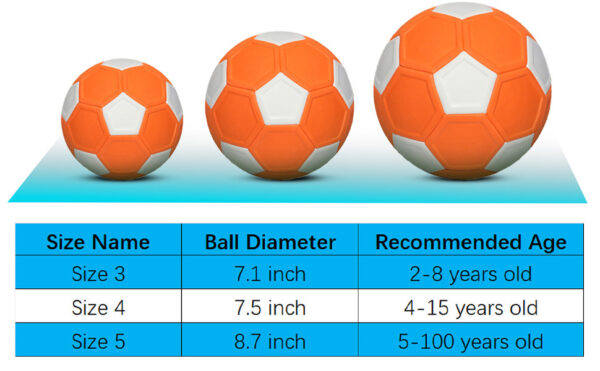
The following chart provides a practical starting point for parents and youth coaches, based on commonly used American youth soccer age divisions and published AYSO guidance.
| Player’s age | Typical age division | Recommended ball |
|---|---|---|
| 2–8 years | U5–U8 | Size 3 |
| 4–15 years | U10–U12 | Size 4 |
| 15 years and above | U14+ | Size 5 |
These are common guidelines rather than a universal rule for every competition. Some organisations use different age cut-offs, and U.S. Soccer has issued a specific recommendation for U13 players that deserves attention.
For example, the American Youth Soccer Organization (AYSO) specifies Size 3 for its younger divisions, Size 4 for U10 and U12, and Size 5 for U14 and older.
That gives parents a useful reference, although checking the rules of the child’s actual league should always come before making a purchase.
READ ALSO | How to Talk to Your Child’s Soccer Coach About Playing Time
What Size Soccer Ball Does A 9-year-old Play With?
A 9-year-old will generally play with a Size 4 soccer ball, particularly in US Youth Soccer and AYSO programmes where the U10 age division uses that size.
The reason comes down to the physical demands of learning football at that stage. Children around nine are developing better coordination, balance and striking technique, although their strength and ability to control a full-size ball are still developing.
A Size 4 ball provides a useful middle ground, allowing players to practise passing over longer distances, receive the ball with different parts of their feet and improve their shooting technique without having to work against the weight of an adult match ball.
There is one detail parents should understand when checking age categories: a player who is nine might belong to a U10 division, depending on the league’s registration calendar. Youth football commonly groups players by their age on a specified date rather than changing their division on their birthday.
That is why the age printed on a birthday card and the age division shown on a team registration form do not always tell the same story.
Understanding Size 3, Size 4 and Size 5 Soccer Balls
The three standard sizes serve different stages of a player’s development, with each one offering a different combination of circumference and weight.
1. Size 3 soccer ball: For younger players aged 4–8
A Size 3 soccer ball is designed for younger children who are beginning to develop their relationship with the ball, particularly during their first organised training sessions and small-sided matches.
It is smaller and lighter than the other standard sizes, making it easier for children to move the ball around without struggling to generate enough power or control.
According to AYSO’s published ball specifications, a Size 3 ball has:
- Circumference: 23–25 inches (58.4–63.5 cm).
- Weight: 10–12 ounces (approximately 283–340 g).
- Typical age group: U5–U8.
At this stage, the priority should be developing familiarity with the ball through dribbling, stopping, turning, short passing and simple shooting exercises.
A smaller ball helps children work on those movements without constantly having to adjust their technique to accommodate a larger object.
For coaches, it also makes training sessions easier to organise because younger players can spend more time touching the ball and less time chasing poorly controlled passes.
Buying recommendation: Choose a Size 3 ball for children aged four to eight, unless their club or competition specifies otherwise.
2. Size 4 soccer ball: For players aged 9–12
The Size 4 soccer ball is the usual choice for children moving beyond introductory football and developing more demanding technical skills.
It is larger than Size 3, although it remains lighter and smaller than the standard adult match ball, giving developing players room to improve their passing range, first touch and shooting technique.
AYSO’s specifications place Size 4 in the U10 and U12 divisions, with the following measurements:
- Circumference: 25–26.5 inches (63.5–67.3 cm).
- Weight: 12–14 ounces (approximately 340–397 g).
- Typical age group: U9–U12 in many youth programmes.
For a nine-year-old, this is generally the appropriate size.
It also gives players enough room to practise more advanced movements, including controlling aerial passes, changing direction under pressure and striking the ball with greater consistency.
One useful point for parents is that Size 4 remains appropriate for many children throughout the primary-school years, so there is little reason to rush towards a Size 5 simply because a child has become physically stronger.
Buying recommendation: Choose Size 4 for most players aged nine to twelve, while checking the competition’s requirements before purchasing.
3. Size 5 soccer ball: For older teenagers and adults
Size 5 is the standard ball used in senior football and most adult competitive matches, including professional competitions governed by the International Football Association Board (IFAB).
It is heavier and larger than Size 4, requiring players to develop the strength, coordination and technique needed to control it consistently.
Under IFAB Law 2, a regulation Size 5 match ball must have:
- Circumference: 27–28 inches (68–70 cm).
- Weight: 14–16 ounces (410–450 g) at the start of the match.
- Typical age group: U14 and older in many traditional youth programmes.
These measurements are particularly relevant because they establish the specifications used in senior football rather than leaving ball selection entirely to manufacturers.
A Size 5 ball also changes the demands of training, especially when players are working on longer passes, powerful shooting, aerial control and match situations involving greater distances.
For a teenager approaching senior football, becoming comfortable with this size is part of adapting to the equipment used at higher levels.
Buying recommendation: Size 5 is the usual choice for players aged 14 and above, subject to the rules of their competition.
READ ALSO | What Soccer Coaches Look for at Tryouts? Inside a Coach’s Evaluator Sheet
Size 4 vs Size 5 Soccer Ball: What Is The Difference?
The difference between a Size 4 and Size 5 soccer ball extends beyond their appearance, with their circumference and weight affecting how players interact with the ball during training and matches.
| Feature | Size 4 | Size 5 |
|---|---|---|
| Circumference | 25–26.5 inches | 27–28 inches |
| Weight | 12–14 oz | 14–16 oz |
| Typical age | 9–12 | 14+ |
| Main users | Youth players | Older teenagers and adults |
| Match use | Youth competitions | Senior football |
A Size 5 ball carries more weight, which can change the amount of force required to strike it and how comfortably a younger player can control it during close technical exercises.
For someone learning to pass, that difference can become noticeable when receiving the ball under pressure or attempting to move it quickly between opponents.
Size 4, meanwhile, offers a more manageable option for developing players who are still improving their coordination and striking technique.
The important point is that a larger ball does not automatically produce a better footballer. Players need to become comfortable with the equipment appropriate to their development stage before progressing.
An Important Exception: U.S. Soccer’s U13 ball recommendation
There is a detail that makes the traditional age chart slightly more complicated, particularly for parents whose children are entering their teenage years.
In 2023, U.S. Soccer approved a recommendation that U13 players use either a Size 4 ball or a lighter Size 5 ball, with Size 4 identified as the preferred option.
The recommendation followed discussions involving medical professionals from U.S. Soccer, MLS and NWSL, alongside research reviewing the relationship between ball size, inflation pressure and head-impact acceleration.
U.S. Soccer’s published guidance states that reducing ball size or using a lighter ball at the U13 stage can help reduce head acceleration and ball-to-head impact.
Its recommended specifications also distinguish between different youth ball categories:
- Under 9: Size 3, weighing 280–310 g.
- Under 11: Size 4 Light, weighing 290–320 g.
- Under 13: Size 4, weighing 350–390 g.
- Over 13: Size 5, weighing 410–450 g.
The U13 recommendation became effective in Fall 2023, meaning the familiar rule of moving every player to Size 5 at 13 should not be treated as universal American guidance.
This is particularly useful for coaches because it shows that player development and safety can influence equipment recommendations, even when a player is physically ready to compete on a larger pitch.
How To Choose The Right Soccer Ball Size: A step-by-step guide for parents
Knowing the recommended size is one thing, although choosing a ball that will actually serve a child’s training needs requires a little more attention than picking the first colourful football on a shop shelf.
Here is a practical way to get it right.
Step 1: Confirm the child’s registered age division
Start by checking whether the child plays in U8, U10, U12 or another age category, rather than relying entirely on their current birthday age.
This matters because registration systems use different cut-off dates, meaning two children of the same age can occasionally play in different divisions.
Step 2: Check the league’s ball requirements
Before buying anything, ask the coach or check the competition handbook for its official ball-size requirements.
This is particularly important for organised matches, where using a ball outside the competition’s specifications can result in the referee or organiser rejecting it.
An incorrectly sized ball does not automatically mean a player will be disqualified, so parents should avoid assuming that every competition applies the same penalties.
Step 3: Check the ball’s weight and circumference
Look beyond the Size 3, Size 4 or Size 5 label and examine the manufacturer’s specifications, especially when buying a ball for younger children.
Two footballs carrying the same size label can have differences in construction, materials and playing characteristics, making the weight specification worth checking.
Step 4: Choose a suitable construction
Soccer balls come in different constructions, including machine-stitched, hand-stitched and thermally bonded designs.
For ordinary youth training, a durable machine-stitched ball can be a sensible purchase, while a better-quality match ball may offer more consistent touch and flight characteristics.
Parents should also consider the playing surface, since a ball regularly used on rough concrete or artificial surfaces may wear differently from one used on natural grass.
Step 5: Check the inflation pressure
Even a correctly sized ball can feel uncomfortable when inflated incorrectly.
Follow the pressure range printed near the ball’s valve, using a pressure gauge rather than relying on how hard the ball feels when squeezed.
An overinflated ball can feel harder on contact, while an underinflated one may behave unpredictably during passing and shooting exercises.
READ ALSO |
Does Using The Wrong Soccer Ball Size Affect Player Development?
Yes, particularly when a child regularly trains with a ball that is poorly matched to their age and physical development.
A younger player using a heavier ball may struggle to produce consistent passes, control rebounds or strike the ball comfortably, especially when attempting techniques that require repeated practice.
Over time, those difficulties can influence how confidently the player approaches basic exercises.
Using a ball that is too small for an older player can also create problems when training sessions are intended to prepare them for the size and weight used in their competitive matches.
This does not mean a coach should never introduce different ball sizes during training. Smaller balls can be useful for particular technical exercises, while lighter balls can help players work on coordination.
The important distinction is between using a different ball as a deliberate training tool and making it the player’s regular match ball.