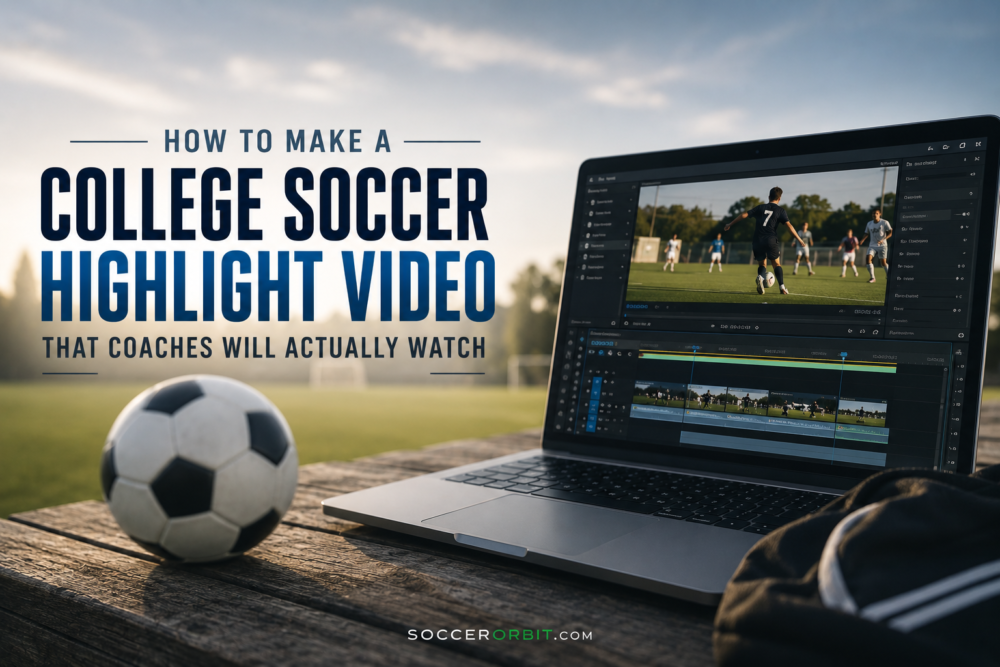
A good recruiting video can change the way a college coach sees a high-school player, especially when the footage gives a clear picture of how that player moves, thinks and influences a match within the first few minutes.
For families working through the college soccer process, putting together a strong soccer highlight video for college recruiting means choosing the right moments from competitive matches, making the player easy to identify and leaving enough of each play for a coach to understand the decision behind the action.
The best videos rarely need elaborate graphics, dramatic editing or a soundtrack that makes every pass feel like a World Cup final. Coaches want to see the player, and they want to see enough of the game to understand what happens before the highlight, during the action and immediately afterward.
That is particularly important for positions where much of the work happens away from the ball. A midfielder may have only a few spectacular moments in a match, yet their scanning, movement, positioning and ability to play through pressure can tell a coach far more about their potential than a collection of isolated goals and tricks.
Your highlight video is therefore not a résumé set to music.
It is the first piece of evidence a coach has when deciding whether your game deserves a closer look, which makes the way you select, arrange and present those clips worth taking seriously.
How Do I Create a Soccer Recruit Highlight Video?

Start with your best recent competitive game footage, then select clips that show the qualities a college coach would want from your position, including technical ability, decision-making, movement, awareness, defensive work and how you affect the game when the ball is not at your feet.
That last part is where many young players miss the opportunity.
A winger who beats three defenders and scores looks great on film, but a coach also wants to see whether that winger makes intelligent runs, tracks back, creates space for teammates and makes the right decision when the obvious dribble is unavailable.
The same principle applies across every position, which means your highlight video should tell a coach what kind of player you are rather than simply showing the occasions when something spectacular happened.
How Long Should a Soccer Highlight Video Be?
There is no NCAA rule requiring every soccer recruiting video to have a particular length, and published recommendations from recruiting resources and college programs vary, which makes quality and program-specific instructions more important than chasing one magic number.
For most high-school field players, three to five minutes is a strong target, while three to six minutes remains a reasonable upper range when the footage is consistently useful and the player has enough high-quality clips to justify the additional time. NCSA recommends three to six minutes and around 20 to 25 game-action clips for field players.
A shorter 90-second to three-minute version can also work particularly well for an initial introduction when the footage is excellent, while a separate longer reel or full matches can give interested coaches more material to evaluate.
Knowing when to introduce yourself to coaches and what to send at different stages of the process can make those early contacts much more effective.
The important rule is simple: never stretch a video to reach a target length.
If your best material lasts two minutes, send two strong minutes rather than five minutes padded with average plays, repeated finishes, slow-motion replays and long stretches where you barely touch the ball.
READ ALSO | The Truth About College Soccer Scholarships: How Many Are Available?
Put Your Best Clips First
The opening section of the video carries more weight than anything you can do with the final minute, because a coach needs to see enough quality early in the tape to decide whether continuing to watch makes sense.
Your first few clips should therefore represent your strongest work from meaningful competition, with the player clearly identified before the action develops.
Avoid the traditional approach of slowly introducing yourself with a long title sequence, club logo, dramatic music and animated graphics before the first soccer action appears.
A coach already knows they clicked on a recruiting video.
Give them the soccer.
Identify Yourself Before Every Play
One of the most practical improvements you can make is making yourself easy to find, particularly when the camera captures several players in the same area.
Use a simple circle, arrow or subtle visual marker before the play begins, then remove it once the coach can clearly identify you.
NCSA specifically recommends footage that gives coaches enough of the field to evaluate vision, movement without the ball, use of space and combinations with teammates, which means excessively tight editing can actually remove some of the information coaches need.
For example, if you are a midfielder making a run before receiving a pass, show enough of the build-up for the coach to see that movement rather than starting the clip immediately before your first touch.
That context can reveal more about your soccer intelligence than the final pass itself.
Build the Video Around Your Position
A good recruiting tape should make sense for the position you are trying to play in college, because coaches are evaluating whether your particular strengths translate into their system and level of competition.
Goalkeepers
Goalkeepers should show saves from different distances, reactions, 1v1 situations, crosses, command of the penalty area and distribution with both feet, while full sequences can be particularly useful because positioning and communication are difficult to judge from isolated saves alone.
Center Backs
Center backs should include 1v1 defending, interceptions, aerial challenges, recovery runs, positioning, passing through pressure and the ability to progress the ball rather than filling the video with only hard tackles.
Fullbacks
Fullbacks can show defending in wide areas, recovery speed, overlapping runs, crossing, combination play, progression and decisions made when receiving the ball under pressure, especially when those actions happen against strong opposition.
Defensive and Central Midfielders
Midfielders should give coaches evidence of scanning, receiving under pressure, passing range, turning away from pressure, switching play, breaking lines, pressing, recovering possession and moving intelligently before the ball arrives.
Wingers
Wingers can showcase 1v1 ability, acceleration, crossing, combination play, movement behind the defensive line, pressing and the quality of their final decision, because beating a defender means much less when the next action consistently breaks down.
Forwards
Forwards should show finishing with different techniques, movement away from the ball, first touch, link play, pressing, runs across defenders, combination play and the ability to create chances rather than relying entirely on goals.
Game Footage Beats Training Clips
Training footage can demonstrate technical ability, but college coaches generally need to see how those skills survive when the game becomes unpredictable, opponents close space quickly and decisions have to be made before you receive the ball.
That is why your recruiting reel should be built primarily around competitive match footage, with training clips used sparingly when they provide something genuinely useful that cannot be shown in a game.
A perfect cone-dribbling sequence tells a coach that you can dribble around cones.
A successful 1v1 against a defender during a competitive match tells them much more about how you apply that ability under pressure.
READ ALSO | How to Write an Email to a College Soccer Coach With (Copy-Paste Templates)
Show Decision-Making, Not Just Highlights
The word “highlight” can create the wrong idea for young players because the best recruiting footage does not need to contain a spectacular action every five seconds.
A simple two-touch sequence that escapes pressure, progresses possession and creates an advantage can be more valuable to a midfielder than another unnecessary skill move.
Likewise, a defender stepping into the correct passing lane before making an interception can tell a coach more than a dramatic sliding tackle that became necessary because the player was initially out of position.
Your tape should show how you think.
That means leaving enough of the play before and after your action for the coach to understand why the decision worked.
Should You Use Music in a Soccer Highlight Video?
When considering highlight video music for soccer, remember that the music should never compete with the footage, and in many cases leaving the natural game sound alone can make the video cleaner and easier to evaluate.
Music is optional rather than essential, and current recruiting guidance generally favors clean editing over flashy effects, heavy transitions and production tricks.
If you use music, keep it low enough that it does not overpower commentary, crowd noise or the natural rhythm of the match.
Avoid songs with explicit lyrics, distracting drops or dramatic editing that makes a normal pass appear like a Champions League final.
The coach is evaluating the player, not the soundtrack.
What Should the Opening Title Card Include?
Your opening information should take only a few seconds and give the coach enough detail to identify you before the first play begins.
Include:
- Full name
- Graduation year
- Primary position
- Secondary position, if relevant
- Club team
- High school
- Jersey number
- Height, where useful
- GPA
- City and state or country
- Contact information
- Video or recruiting profile link
You do not need to squeeze every achievement from your soccer résumé onto the screen, because the email or recruiting profile can carry the additional information.
The Best Video Editor for Soccer Highlights
The best video editor for soccer highlights is usually the one you can use confidently enough to produce clean cuts, accurate player identification, readable text and good video quality without spending most of your time fighting the software.
For beginners, CapCut can handle straightforward trimming, text overlays and markers, while DaVinci Resolve offers much deeper editing control for families willing to learn a more advanced program.
Adobe Premiere Pro is another powerful option for experienced editors, although paying for professional software makes little sense if the only goal is a three-minute recruiting reel.
If your games are already recorded and organized through Hudl, using the footage and tools available through that platform can also simplify the process, particularly when coaches are already familiar with receiving recruiting film through established sports-video services.
The software matters far less than the final result.
Keep the Editing Simple
A recruiting video should look professional because it is easy to watch, not because it contains ten different transitions.
Use straightforward cuts, readable text and one consistent way of identifying yourself throughout the video.
Avoid spinning logos, giant animations, repeated replays, unnecessary slow motion and effects that obscure the field, because every second spent showing the editing is a second that could have been spent showing your soccer.
The strongest edit often feels almost invisible.
Include Full-Game Film Separately
Your highlight reel gets the coach interested, while full-game footage gives the coach a chance to understand whether those highlights represent your normal level of play.
This difference matters because isolated highlights can hide positioning errors, poor decisions, inconsistent work rate and long stretches where the player disappears from the match.
Keep at least one or two complete recent matches available through a clean link, preferably from a wide enough camera angle to show the entire field and your movement away from the ball.
NCSA and other soccer recruiting guidance emphasize the value of game footage because coaches need to assess vision, movement, positioning and decision-making rather than simply watch isolated technical moments.
How Parents Can Help Without Taking Over
Parents often become heavily involved early in the recruiting process, and the NCAA itself notes that parents or guardians commonly lead parts of the process during ninth and tenth grade, while encouraging students to take ownership of communication as they move toward eleventh and twelfth grade.
That same approach works well with video.
Parents can help organize match footage, keep copies of important games, check audio and image quality, maintain a list of schools and coaches, and make sure links continue working.
The player should still understand every clip in the video and be able to explain their position, strengths, academic situation and reasons for being interested in each program. That self-awareness also becomes important when comparing the different levels of college soccer and identifying programs that match a player’s ability, goals and overall situation.
A coach recruiting a student-athlete eventually needs to communicate with the player, not only the parent managing the process.
Update the Video as Your Game Changes
Do not keep sending the same highlight reel for an entire recruiting cycle when your level, position, club, competition or role has changed considerably.
A midfielder who becomes more defensive during the following season may need a different collection of clips, while a forward who moves into a stronger league should replace older footage with recent performances against better opposition.
Your most recent quality film should normally lead the conversation, while older footage can remain available when it adds useful evidence.
The same principle applies to academic information and schedules, which should remain current whenever you contact coaches.
Final Checklist
Before sending your video for college recruiting, watch the entire video once without touching the editing software and judge it as though you had never seen the player before.
Make sure the opening clips are your strongest material, your identity is obvious, every clip shows you clearly, the footage comes primarily from competitive games, and there is enough context to evaluate your decisions rather than only the final action.
Check that the video link works on both a computer and phone, the audio is comfortable, the image is clear, the title information is accurate, and the full-game footage is available separately.
Most importantly, remove anything that makes a coach work unnecessarily hard to find your game.
College recruiting video does not need Hollywood production.
It needs good soccer, smart selection and honest evidence of what you can bring to a team.
The NCAA’s current recruiting guidance continues to emphasize athletic ability, academics, exposure and an understanding of the communication rules that apply to each division and stage of the recruiting process.
Your video therefore works best as one part of a larger introduction, alongside your academic profile, recruiting email, schedule, club information and eventually the opportunity for a coach to watch you play in person.
When those pieces line up, the highlight reel has done its job. It has made the first evaluation easier and given the coach a reason to watch the next match.