Sending your first email to a college soccer coach can feel like a bigger deal than it actually is, especially when you know that a few lines on a screen could be your first introduction to a program you have been following for months.
An effective email should help a coach understand who you are, what position you play, why you are interested in the program, and where they can quickly watch you play, all without making them dig through a long message to find the important details. College coaches receive large volumes of recruiting emails, so the strongest messages are personal, specific, easy to scan, and backed by useful information about your soccer and academic profile.
For a high-school player, the first email can feel like a much bigger moment than it really is, because you are essentially introducing yourself to someone who could influence the next stage of your soccer career, but the goal is not to write a perfect sales pitch.
The goal is to start a recruiting conversation.
That difference matters because coaches are evaluating more than your highlight vids, and your email gives them an early look at how you communicate, how seriously you approach the process, and whether you have taken the time to understand their program.
What Should I Write in an Intro Email to a College Soccer Coach?

When deciding how to introduce yourself to a college soccer coach, build the email around five things that allow the coach to evaluate your potential quickly: your identity and graduation year, your position and club or high-school team, your strongest athletic and academic information, your reason for being interested in the school, and a clear link to your video or recruiting profile.
The NCAA itself notes that recruiting communication varies by division and grade level, while also encouraging prospective student-athletes to understand the recruiting process and take greater ownership of communication as they move through high school.
A useful opening might therefore tell the coach that you are a 2028 midfielder from a particular club, mention your location and academic standing, then explain why you have been following their program and would like to be evaluated.
That gives the coach context immediately, while the rest of the email provides the evidence behind your introduction.
READ ALSO | How Much Does Travel Soccer Cost? Full Financial Breakdown
Before You Email a College Soccer Coach
Research the program before writing anything, because a message that could have been sent to 50 different schools usually feels like exactly that, while a short reference to the coach, playing style, recent season, academic program, location, or roster situation can show that you have done your homework.
You should also find the correct coach and use the official athletic department website whenever possible, since college staff directories and team pages commonly provide current coaching information and contact details.
Before sending your email, have these details ready:
- Your full name and graduation year.
- Your primary and secondary positions.
- Your height, if relevant to your position.
- Your club and high-school teams.
- Your city, state, country, or region.
- Your GPA and relevant academic information.
- Your key soccer achievements and statistics.
- Your upcoming competition schedule.
- A recent highlight video.
- Full-game footage, if available.
- Your club or high-school coach’s contact information.
- Your phone number and professional email address.
If you are an international student, you should also understand the NCAA eligibility process early, because international student-athletes have additional academic and athletics certification requirements, with country-specific guidance available through the NCAA Eligibility Center.
Subject Lines for Recruiting Emails
Your subject line has one job, which is to give the coach enough useful information to understand who you are and why the message deserves attention before they open it. Knowing when to introduce yourself, what information to include and how your outreach should develop over time is also part of understanding the wider college recruiting process.
Good subject lines for recruiting emails normally include your name, graduation year, position, and one useful detail such as your club, location, GPA, tournament, or video.
Some strong examples include:
- 2028 Midfielder | Seth Cohen | Pasadena | Video
- 2027 Center Back | James Carter | 3.8 GPA | Highlights
- 2029 Winger | David Mensah | [Club Name] | Recruiting Video
- 2027 Goalkeeper | Michael Brown | 6’2″ | Full-Game Film
- 2028 Forward | Daniel Smith | [Tournament Name] | July Schedule
NCSA recommends keeping recruiting subject lines concise because coaches often read email on mobile devices, with roughly 50 to 75 characters providing a useful target for keeping the important information visible.
Avoid subject lines such as “Please Recruit Me,” “Future Soccer Star,” or “I Want to Play for Your Team,” because they tell the coach very little before opening the message and can make the email feel generic.
How to Structure Your First Recruiting Email
The best introductory email usually follows a simple structure that allows a coach to move from identification to evaluation without having to search through unnecessary background information.
1. Introduce Yourself Clearly
Your first paragraph should establish your name, graduation year, position, school or club, location, and the reason you are contacting that particular coach.
2. Explain Why You Chose Their Program
This is where personalization matters most, because mentioning something specific about the team, coaching staff, academic program, playing style, conference, campus, or development pathway shows that your interest extends beyond simply wanting a scholarship.
3. Give the Coach Useful Soccer Information
Choose two or three details that help the coach understand your level rather than dumping every trophy, tournament, and statistic you have collected since childhood.
For example, you might mention your position, minutes played, goals and assists, defensive role, club level, tournament performances, team achievements, or a particularly useful strength that fits the way the coach’s team plays.
4. Include Academics
College soccer recruiting is not purely about what happens on the field, because coaches and schools also need to understand whether you can meet the academic requirements of the institution and, where applicable, the relevant NCAA eligibility standards.
For Division I athletes, the NCAA currently requires 16 NCAA-approved core-course credits and applies the 10/7 requirement, meaning ten core courses, including seven in English, mathematics, or science, must be completed before the beginning of the seventh semester.
5. Give Them Something to Watch
A recent highlight video can introduce your game, but knowing how to put together footage that catches a coach’s attention can make those first few minutes count, while full-match footage gives coaches a much better opportunity to assess your decision-making, movement away from the ball, positioning, work rate, and consistency.
Your video link should be easy to find, work without requiring complicated access, and begin with your name and position so the coach can identify you immediately.
6. End With a Simple Next Step
Instead of asking the coach for a scholarship in your first email, ask whether they would be willing to evaluate your video, watch you at an upcoming event, or speak with you about the program when NCAA rules permit that communication.
That creates a much more natural opening for the conversation.
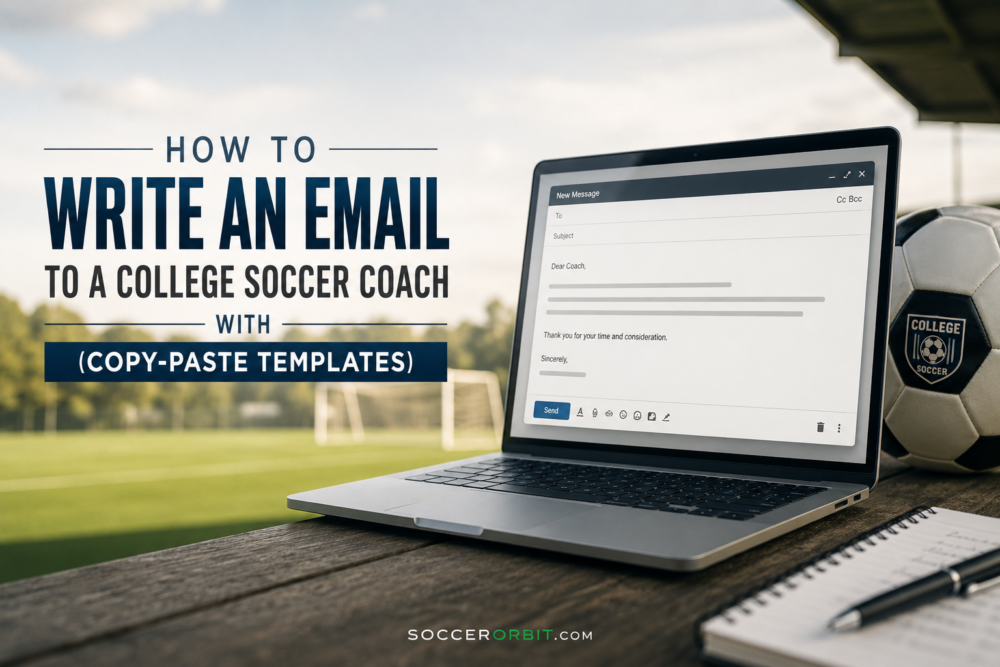
Email College Soccer Coach Template
The following template works well as a starting point, but you should rewrite the school-specific section for every program rather than sending the exact same message to dozens of coaches.
Dear Coach [Last Name],
My name is Seth Cohen, and I am a 2028 midfielder at [High School] and [Club Name] in [City, State/Country]. I am reaching out because I am very interested in [College Name] and would like to introduce myself as a potential recruit for your soccer program.
I have been following [College Name] because [specific reason about the team, coaching style, academic program, recent season, or campus], and I believe the environment could be a strong fit for my development as both a student and a soccer player.
I currently play [position] and my strengths include [two or three specific strengths]. This season, I have [relevant statistics, achievements, tournament performances, team accomplishments, or other useful information]. Academically, I have a [GPA] and I am currently taking [relevant courses or academic information].
My recent highlight video is available here: [VIDEO LINK]
I have also included my upcoming schedule here: [SCHEDULE LINK], and I would be grateful if you could take a look at my video and let me know whether my profile could fit what you are looking for in the [graduation year] recruiting class.
Thank you for taking the time to read my email, and I would appreciate the opportunity to learn more about your program and what you look for in players at my position.
Best regards,
Seth Cohen
Class of 2028 | Midfielder
[Club Name] | [High School]
[Phone Number]
[Email Address]
[Video/Profile Link]
A Shorter Version for Busy Coaches
A shorter email can work particularly well when you have strong video and profile information available, because the coach can quickly identify you, understand your interest, and move directly to evaluating your game.
Dear Coach [Last Name],
My name is Marcus Johnson, and I am a 2027 winger with [Club Name] in [City, State/Country], currently attending [High School]. I am contacting you because I am very interested in [College Name], particularly because of [specific reason connected to the program].
I have [GPA], and my current soccer profile includes [key achievement/stat], while my main strengths are [strength 1], [strength 2], and [strength 3]. My latest highlight video is available here: [VIDEO LINK], and my upcoming schedule is available here: [SCHEDULE LINK].
I would appreciate it if you could evaluate my video and let me know whether you feel my profile could fit your recruiting needs for the [graduation year] class.
Thank you for your time, and I hope to hear from you.
Best regards,
Marcus Johnson
Class of 2027 | Winger
[Club Name] | [High School]
[Phone] | [Email]
When to Email College Coaches
The answer to when to email college coaches depends partly on the recruiting calendar, the division, the athlete’s graduation year, and whether you are sending an introductory message or following up after previous contact.
There is no universal hour that guarantees a response, because coaches have different schedules and may be travelling, recruiting at tournaments, preparing for matches, or dealing with their own season, while recruiting rules also determine when coaches can communicate with prospective student-athletes.
For the email itself, sending during reasonable daytime or early evening hours can make sense, while NCSA’s guidance suggests Tuesday through Sunday between approximately 4 p.m. and 8 p.m. based on its own data, although the coach’s schedule and recruiting calendar matter more than chasing a particular hour.
For NCAA athletes, always check the current rules for your sport and division rather than assuming that because you can email a coach, the coach can immediately respond in the same way, because recruiting communication restrictions can differ by division and grade level.
What to Do If the Coach Does Not Reply
A lack of response does not automatically mean that a coach has rejected you, because recruiting staffs receive substantial email volume and your message may arrive during a busy part of their season or at a point when they are focused on other recruiting priorities.
Give the coach several days before following up, then send a short message that adds something useful, such as a new highlight video, an upcoming tournament schedule, a strong academic update, or a specific event where you will be playing.
Your follow-up should feel like a continuation of the conversation rather than another copy of your original email.
Dear Coach [Last Name],
I wanted to follow up on my previous email and share my updated schedule for [Tournament/Event Name], where I will be playing with [Club Name] on [Date]. I remain very interested in [College Name], particularly because of [specific reason], and I would appreciate the opportunity for you to evaluate me if your schedule allows.
My updated video is available here: [VIDEO LINK], while my full schedule is available here: [SCHEDULE LINK].
Thank you again for your time and consideration, and I hope to have the opportunity to connect with you during the recruiting process.
Best regards,
Smith Hayes
Class of 2028 | Midfielder
[Club Name] | [High School]
[Phone] | [Email]
Mistakes That Can Hurt Your First Email
The most common mistake is writing too much, because a coach needs to identify your recruiting class, position, level, academics, video, and reason for contacting the program without reading an autobiography about your entire soccer career.
Other mistakes worth avoiding include sending the same message to every school, using the wrong coach’s name, forgetting your graduation year, attaching enormous video files, sending broken links, exaggerating statistics, using an unprofessional email address, failing to mention academics, and contacting a coach without understanding the applicable recruiting rules.
You should also make sure your social media presence represents you responsibly, because recruiting guidance commonly recommends reviewing public social accounts before beginning outreach, while your current coaches should know which schools you are contacting so they can respond intelligently if a college staff member asks about you.
READ ALSO | Birth-Year vs. School-Year Registration in U.S. Soccer
The Email Is Only the Beginning
A strong recruiting email can open a door, but your video, full-game performances, academic record, communication, coachability, and consistency will determine what happens after that first introduction. It also helps to understand how the different NCAA divisions compare, since the recruiting environment and expectations can vary between Division I, Division II and Division III programs.
For international players, the process deserves even more preparation because NCAA eligibility can involve academic records from another education system, sports participation history, amateurism requirements, and documentation that needs to reach the Eligibility Center correctly.
The NCAA currently advises prospective student-athletes to register early with the Eligibility Center, and Division I and Division II athletes generally need an Academic and Athletics Certification account, while international Division III athletes need athletics certification.
The strongest approach is therefore simple: research the school, personalize the email, make your soccer level easy to evaluate, show that your academics are in order, provide accessible video, and give the coach a clear reason to respond.
Your first email does not need to convince a coach that you are the next star of college soccer, because it only needs to make the coach interested enough to watch you play.