
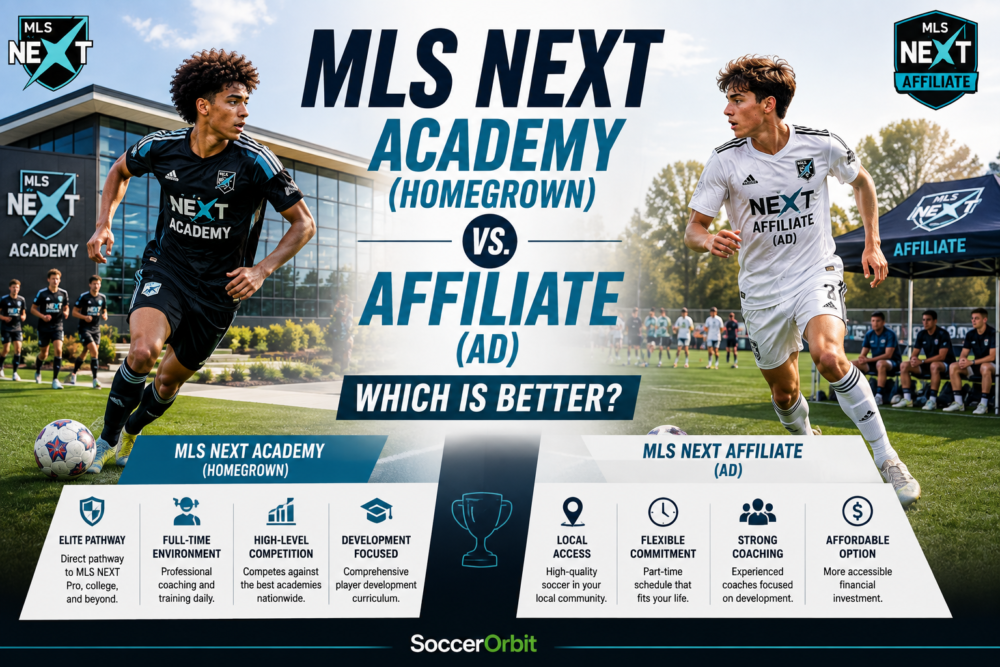
MLS NEXT Homegrown vs Academy Division has become one of the most confusing parts of American youth soccer, largely because the words MLS, academy, Homegrown and professional are often used together even though they can describe very different things.
A player joining an MLS professional academy, a player joining an independent club in the MLS NEXT Homegrown Division and a player joining a non-professional club in the MLS NEXT Academy Division may all technically be inside the MLS NEXT ecosystem, but the training environment, professional access, competition level, cost and long-term pathway can look very different.
That matters even more in 2026, because MLS NEXT is no longer a single-tier competition.
The organization launched the Academy Division in 2025-26, creating two official levels of MLS NEXT competition, with the Allstate Homegrown Division at the top and the Academy Division below it. For the 2026-27 season, MLS NEXT is set to cover 318 clubs and more than 53,000 players across both divisions in 40 states plus Washington, D.C.
The Homegrown Division contains 152 clubs, including all MLS academies and 123 MLS NEXT Elite Academies, with more than 17,000 players competing in the top division.
The Academy Division has grown quickly as well, with about 230 clubs and 25,000 players during its first season, and another 47 clubs joining the division for 2026-27.
That expansion creates opportunity, but it also creates confusion.
For parents comparing offers, the first job is to understand what the badge actually means.
The MLS NEXT Pyramid Has Two Levels
The cleanest way to understand MLS NEXT tiering is to separate the competition division from the type of club.
The Allstate Homegrown Division is the top MLS NEXT competition.
The Academy Division is the second MLS NEXT competition.
An MLS professional academy is a club academy operated by an MLS franchise, such as an MLS first-team organization with a formal youth development system.
An independent MLS NEXT club is a youth organization that has earned membership in MLS NEXT but does not belong to an MLS professional franchise.
Those categories overlap in ways that can confuse families.
An MLS professional academy competes in the Homegrown Division, but many Homegrown Division clubs are not owned or operated by MLS franchises. MLS NEXT says its Homegrown Division includes all MLS academies alongside 123 MLS NEXT Elite Academies, meaning the division itself should not be interpreted as “MLS professional academies only.”
The Academy Division is different.
It was created to broaden participation while maintaining MLS NEXT technical standards, and its membership includes many independent clubs that are not connected to a professional MLS team. MLS NEXT says the division brought together additional teams from existing MLS NEXT clubs and more than 100 newly admitted clubs when it launched.
That difference is the foundation for everything else.
MLS Pro Academy & MLS NEXT Academy Division Are Not The Same Thing
The word “academy” causes much of the confusion.
An MLS academy is connected to a professional MLS franchise, which means its players sit inside a professional club’s player-development system.
The MLS NEXT Academy Division is a competition level within MLS NEXT, and a club playing there does not automatically have a professional MLS affiliation.
Those are two very different propositions.
A boy training with an MLS club academy may have access to professional academy staff, club scouting structures and a pathway that connects youth development to the professional side of the organization.
A boy playing for an independent Academy Division club may receive excellent coaching and compete against strong opponents, but his club does not suddenly become a professional MLS academy because its teams joined MLS NEXT.
That difference should be written in large letters on every parent’s comparison sheet.
The league badge tells you where the team competes.
It does not tell you who owns the club, who employs the coaches, how the academy is funded or how close the player actually is to a professional pathway.
Choosing between MLS NEXT Academy and an Affiliate is only part of the decision for parents. The level of competition, player development and long-term pathway also matter, much like the differences between ECNL and ECNL Regional League
Homegrown Does Not Always Mean Free
The term Homegrown Division creates another misunderstanding.
MLS calls it the pinnacle of its youth player-development platform, and the division contains all MLS academies along with a large group of elite independent clubs. The competition operates over a 10-month pro-style season and includes MLS NEXT Fest, Generation adidas Cup, MLS NEXT Flex and MLS NEXT Cup.
The professional academies attached to MLS franchises are where the financial difference can become dramatic.
MLS professional academies have historically operated with heavily subsidized or fully funded player development, giving selected players access to an environment that can include professional coaching, facilities, scouting and other resources without the kind of annual family bill associated with traditional pay-to-play clubs.
But an independent Homegrown club is another matter.
Its players can still pay club tuition, travel costs, uniforms and other expenses.
The Homegrown label therefore tells you the competitive tier, not the price of the program.
A family should never hear “MLS NEXT Homegrown” and assume the program is automatically free.
The club’s ownership and funding structure matter.
The Academy Division Was Built Around a Different Lifestyle
The second MLS NEXT tier was created partly to expand access to high-level competition without forcing every player into the highly demanding calendar associated with the top division.
The Academy Division regular season is regionally focused and designed around high school calendars, allowing its players to participate in high school soccer while remaining inside the MLS NEXT ecosystem.
That is a major selling point for families.
A player can pursue elite club soccer while still representing his high school, which can matter enormously to teenagers who value the social side of school sports or attend schools where soccer is an important part of the community.
The Academy Division also competes in regional conferences before moving into regional tournaments that serve as qualifiers for MLS NEXT Cup, alongside MLS NEXT Fest and MLS NEXT Cup opportunities.
The structure is therefore more than a collection of local second teams.
There is a national framework around it.
The difference is that the regular season is more regionally organized and the division sits below Homegrown in the MLS NEXT hierarchy.
The Two Divisions Are Moving Closer
The interesting part of MLS NEXT’s expansion is that the Academy Division was not created as a permanent parking place for clubs that could never reach the top level.
MLS NEXT evaluates clubs annually, and new clubs accepted into the system are generally placed into the Academy Division unless MLS NEXT identifies them for another placement. The organization evaluates membership using factors including club philosophy, leadership, player pool, coaching expertise, facilities, daily performance environment, geography and the club’s ability to reduce or eliminate player costs.
That creates a pathway upward.
For 2026-27, seven clubs were announced for the Homegrown Division, with five of them advancing from the Academy Division after strong performances on and off the field.
That movement matters because it gives the second tier a purpose beyond simply providing another place for players to compete.
A strong Academy Division club can build its program, improve its player pool and eventually earn promotion into the top MLS NEXT tier.
The player pathway can develop alongside the club pathway.
The Talent Gap Depends Heavily On Geography
The MLS NEXT Homegrown vs Academy Division talent gap is difficult to measure with one national statement because the strength of the Academy Division varies considerably from one market to another.
Some Academy Division clubs have deep player pools, experienced technical directors and coaches who have worked at elite levels for years.
Others entered the system more recently and are still building the infrastructure required to compete consistently against established elite programs.
The 2026-27 expansion makes that variation even more important.
MLS NEXT announced 47 new Academy Division clubs for the upcoming season, including organizations ranging from established youth programs to newer development operations across different parts of the country.
That means a top Academy Division team in one region can look very different from a lower-ranked team somewhere else.
The same principle applies within clubs.
An Academy Division team can contain players who are close to Homegrown level, especially when a club has strong internal movement between teams.
Another Academy Division roster may sit much further away from the level of a strong Homegrown side.
Parents should therefore compare the actual teams, not the names of the divisions alone.
MLS NEXT Tiering Can Make The Same Club Look Different
The tiering becomes especially interesting when a club has teams in both divisions.
A player might have access to a Homegrown environment at the same organization where another player competes in the Academy Division, and the difference between the two groups may involve more than match quality.
Training schedules can differ.
Competition calendars can differ.
High school eligibility can differ.
Player movement rules can differ.
The coaching structure can differ.
The expectations placed on the players can differ.
For families, this means the question should not stop at “Is this an MLS NEXT club?”
The better information is much more specific.
Which division is the team in, what player status will my child have, and what happens if the player develops faster than expected?
Those answers reveal the actual pathway.
Homegrown Carries Professional-development Identity
The Homegrown Division operates around a 10-month pro-style calendar and includes several national events designed around elite development, scouting and international competition. Generation adidas Cup, in particular, brings MLS academies and selected MLS NEXT Elite Academies into competition with professional youth clubs from around the world.
That environment can be extremely valuable for a player who wants to test himself against the strongest available competition.
It also creates a more demanding lifestyle.
Training becomes a major part of the week.
Travel becomes harder to avoid.
High school participation can become complicated for players in the top pathway, depending on their player status and the applicable rules.
The Homegrown route therefore suits families who are prepared to make soccer a major part of the player’s weekly life.
The Academy Division takes a different approach by working around the high school calendar.
For some families, that flexibility will matter more than the difference in league status.
The Academy Division Has One Advantage Parents Should Not Overlook
The ability to play high school soccer can be a major benefit.
For teenagers, the school team provides an experience that club soccer cannot fully replace, because the player is competing alongside classmates and representing a school rather than a private club.
MLS NEXT explicitly designed the Academy Division around high school calendars and permits Academy Division players to participate in high school soccer.
That creates an unusual middle ground.
A player can remain in the MLS NEXT ecosystem, play against high-level opponents and attend MLS NEXT national events while also taking part in the high school season.
For a family that wants both, the Academy Division can be a much better fit than an otherwise stronger program with restrictions that remove school soccer from the calendar.
The decision becomes especially personal for U15 through U19 players, when the high school experience becomes more important and college recruiting begins to accelerate.
The College Pathway Exists In Both Divisions
Playing in the Academy Division does not remove a player from college recruiting.
MLS NEXT says Academy Division regional tournaments serve as MLS NEXT Cup qualifiers and also provide talent-identification opportunities for college, professional and national-team scouts.
The Homegrown Division naturally carries a larger concentration of elite talent and professional scouting, but college coaches do not recruit players according to league labels alone.
They recruit players who can help their programs.
That means an Academy Division starter who plays major minutes, produces consistently and has strong film can become more attractive to a college coach than a Homegrown player who rarely sees the field.
Recruiting is built around performance, projection, academics and fit.
The competition level creates the first layer of exposure.
The player has to create the rest.
Is MLS NEXT Non-pro Affiliate Worth The Money?
The answer depends almost entirely on the club and the player’s role.
An independent Academy Division club can be worth paying for when it provides a strong training environment, excellent coaching, serious regional competition, national-event access, meaningful playing time and a clear route toward the Homegrown Division or college soccer.
It becomes much harder to justify when the main selling point is the MLS NEXT name while the underlying environment looks similar to a much cheaper local program.
This is where parents need to look beyond the badge.
A current 2026-27 example comes from Blackhawks Soccer, which lists its MLS NEXT Academy Division U13-U14 program at $3,350 before additional travel, uniforms and other team costs, with the club estimating another $1,600 to $3,200 in travel expenses and team fees.
AC River’s 2026-27 published pricing also lists both Homegrown and Academy Division options, with its early enrollment pricing starting around $3,471 and travel fees included in the quoted program price.
These examples are not national averages.
They show why families need to compare the entire package rather than assuming every Academy Division club costs the same.
MLS NEXT membership does not set one universal parent tuition.
The club sets the family bill.
The Cost Needs to be Measured
A $4,000 program can be expensive if the player receives ordinary coaching and limited competition.
The same amount can look very different when it provides four high-quality training sessions each week, strong coaching, serious competition, video analysis, college guidance and regular playing time against players who push the child’s development.
Parents should calculate the full annual commitment before signing.
The list should include:
- Club tuition and registration
- Team fees
- Uniforms and equipment
- Tournament expenses
- Flights and long-distance transportation
- Hotels
- Meals during travel
- Private training
- Strength and conditioning
- Showcase expenses
- College recruiting support where applicable
- Any mandatory fundraising or additional club fees
Travel can also change the calculation because MLS NEXT is reorganizing Academy Division conferences for 2026-27 partly to improve scheduling efficiency, increase regular-season opportunities and reduce travel costs.
That suggests the league itself recognizes that geography affects the value families receive from the program.
A regional schedule that keeps a family on the road for four hours every other weekend still carries a cost, even when the club fee looks reasonable.
Player Who Plays Can Gain MoreThan Player Who Sits
This is where parents can get trapped by the prestige of the top division.
A Homegrown roster spot sounds better.
It may also provide a higher training level.
But if a young player is consistently near the bottom of the depth chart, the developmental value needs to be examined carefully.
Players learn by playing.
They need to receive the ball under pressure, make decisions, lose possession, recover, defend space, communicate and handle the consequences of their choices.
A player who starts every week in Academy Division may receive far more responsibility than a player who spends the season watching from a Homegrown bench.
That does not make Academy Division better.
It means development has more than one ingredient.
The ideal situation is a player who is challenged by the environment while still receiving enough responsibility to grow inside it.
MLS Academy vs Non-pro Academy
The biggest financial and professional misunderstanding comes from assuming every MLS NEXT team has the same relationship with Major League Soccer.
It does not.
An MLS professional academy belongs to an MLS franchise and operates within that club’s professional development structure.
A non-pro MLS NEXT club is an independent youth organization that has earned a place in the MLS NEXT competition system.
An Academy Division club can provide an elite environment without providing direct access to a professional MLS organization.
That does not make the club poor.
It simply means parents should pay for the coaching, competition, development resources and pathway the club actually provides, rather than paying for an imagined professional connection that does not exist.
The distinction becomes even more important when a club’s marketing uses terms such as academy, professional pathway or MLS development.
Ask exactly what those words mean.
The Next Level is Not Always The Next Division
One of the healthiest things about the new MLS NEXT structure is that it creates more than one way for a player to progress.
A player can move from Academy Division to Homegrown.
A club can move upward.
A player can attract the attention of an MLS professional academy.
A player can move into college soccer.
Another player may discover that his best route is through a strong independent club before moving into a professional environment later.
The pathway is not perfectly linear.
That matters because youth players develop at different speeds.
Physical maturity changes.
Positions change.
Confidence changes.
A player who looks ordinary at 13 can look completely different at 16 after three years of better coaching and more responsibility.
The right environment therefore needs to leave room for movement.
What Parents Should Know Before Accepting an MLS NEXT Offer
The strongest questions are practical ones that force the club to explain what the player will actually receive.
- Which MLS NEXT division is the team entering for 2026-27 (or particular year), and what player designation applies to my child?
- Is the club affiliated with an MLS professional franchise or operating independently?
- Where do players from this age group move after MLS NEXT?
- How many Academy Division players moved into Homegrown last season?
- Can strong Academy Division players train with the Homegrown group?
- What happens if my child is not getting enough playing time?
- Can the player participate in high school soccer?
- What is the complete annual cost after travel and team expenses?
- How many national events are mandatory rather than optional?
- Who specifically is responsible for college recruiting and player identification?
The answer to those questions will tell a parent more than the MLS NEXT logo on the offer letter.
Decision Becomes Clear When The Player Comes First
MLS NEXT Homegrown remains the top tier of the MLS NEXT system, with a 10-month pro-style calendar, the strongest competition inside the platform and a direct professional pathway for players who reach the level required by MLS academies and other elite organizations.
The Academy Division is a lower tier, but it has quickly developed into a substantial national competition with more than 25,000 players, regional conferences, national events and a pathway toward the Homegrown Division.
For a player who has a place in a professional MLS academy, the Homegrown environment can offer an extraordinary development opportunity, particularly because the player’s training is connected to an actual professional club rather than simply a league membership.
For a player choosing between an independent Homegrown club and a strong Academy Division program, the answer becomes much less obvious.
For a player who values high school soccer, the Academy Division’s calendar can be a major advantage.
For a player who needs more playing time, a strong AD team may provide more development than sitting on the edge of a Homegrown roster.
For a player chasing the professional game, the quality of the individual club and its connections to professional scouting may matter more than the division label.
And for parents, the financial question needs to be answered without the emotion that often surrounds elite youth soccer.
MLS NEXT membership is not the product. The training environment is the product.
The division determines the level of competition and the structure around it, but the coach, teammates, facilities, playing time, travel schedule and player pathway determine what the family actually receives.
That is why the smartest comparison is not simply Homegrown vs Academy Division.
It is this Homegrown opportunity versus this Academy Division opportunity, with the player standing in the middle of the comparison.
The MLS NEXT system is still evolving, and its two-division structure is only entering its second full season in 2026-27. Five Academy Division clubs have already moved into Homegrown for the new season, while dozens of additional clubs are entering the Academy Division, giving the lower tier more depth and making the pathway increasingly important.
The hierarchy is clear.
Homegrown sits at the top. Academy Division sits below it. MLS professional academies are a separate concept from the division names.
Beyond that, the details matter.
A player should not pay thousands of dollars for a badge.
He should pay for a place where the coaching is good, the competition pushes him, the playing opportunities are meaningful and the next step remains visible.
That is what makes an MLS NEXT program worth the money.
For parents comparing the wider youth soccer path, it is also worth looking at how MLS NEXT stacks up against ECNL, especially when considering competition, player development, college exposure and the right environment for your child. Our guide to MLS NEXT vs ECNL breaks down those differences.