
ECNL vs ECNL Regional League is a decision that can look much bigger than it really is when families first enter the upper levels of American youth soccer, because the two platforms share the same ECNL name, operate inside the same broader competition pyramid and can sometimes feature players who are much closer in ability than the labels suggest.
The simplest answer to the exact search query, “What is the difference between ECNL and ECNL RL?”, is that ECNL is the higher national competition level, while ECNL Regional League, usually called ECNL RL, sits beneath it as the next major level in the ECNL club pathway.
That description is accurate, but it leaves out the part that matters to families.
ECNL RL is not simply a watered-down version of ECNL where players go when they cannot make the top team. It has become a large national platform of its own, with hundreds of clubs, regional competition, postseason events, college recruiting opportunities and a formal pathway for clubs to earn promotion into ECNL.
For the 2026-27 season, ECNL Boys will have more than 170 clubs across 15 conferences, while ECNL Regional League Boys will feature more than 390 clubs across 26 regional leagues. On the girls side, ECNL has 129 clubs across 10 conferences, while ECNL Regional League Girls will have more than 375 clubs across 25 regional leagues.
That scale tells us something important.
The gap between the two levels exists, but it is not a clean line drawn across every club, age group or player.
The ECNL Pyramid Is More Complicated
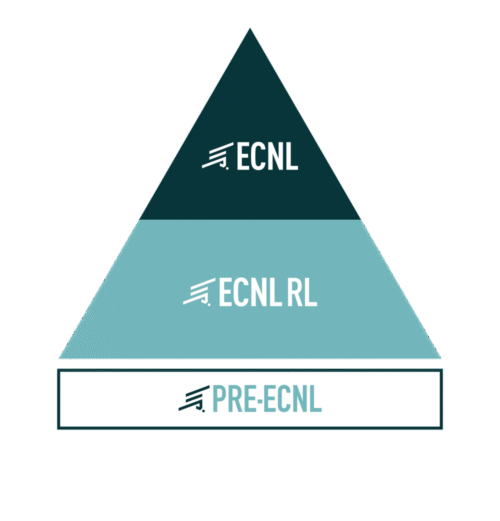
The easiest way to understand the structure is to think of ECNL as a club pathway rather than a single league with a backup division.
At the top sits the ECNL, the national competition platform that most families mean when they say a player has “made ECNL.”
Below it sits the ECNL Regional League, which provides high-level regional competition for clubs that are either building toward ECNL, developing additional teams within the ECNL ecosystem or competing at a level that has earned a place in the regional platform.
Below that, the ECNL has also been expanding Pre-ECNL, giving younger players another route into the broader structure.
The movement between these levels has become one of the more interesting parts of the system.
For 2026-27, ECNL announced more than 60 clubs moving up or entering its competition pyramid, including 14 clubs promoted into ECNL and 46 promoted into ECNL Regional League. The organization also announced 11 new Pre-ECNL leagues.
This is not a static ladder.
Clubs can improve, prove themselves and move upward.
That matters because the ECNL Regional League is increasingly functioning as a proving ground rather than a permanent destination for every club that enters it.
What Separates ECNL from ECNL-RL?
The clearest difference is the level and scope of competition.
ECNL operates as the higher national platform, with clubs competing in conferences and then moving toward national postseason competition.
ECNL RL is more geographically organized, which reduces some of the travel burden while still giving players access to competition beyond their immediate local market.
That regional structure is part of the appeal.
A player does not necessarily need to fly across the country every other weekend to find serious competition, while the strongest teams can still earn opportunities to play on larger postseason stages.
The difference can also be seen in the way the postseason is organized.
In 2026, hundreds of ECNL RL teams competed through five regional playoff events, with qualifying teams advancing to the ECNL Regional League Finals. The Boys Finals brought 40 teams to Richmond, Virginia, while ECNL Boys had 20 teams advancing from its national playoffs.
ECNL RL therefore has its own competitive identity.
It is not merely a local league wearing a national brand.
The Talent Gap is Real
The phrase ECNL vs RL talent gap makes the difference sound more straightforward than it usually is.
At the strongest clubs, the ECNL roster will generally contain the club’s highest-level players, and the RL roster will sit beneath it.
That is the basic structure.
But youth soccer does not produce players in neat rankings.
A club’s eighth-best ECNL player may be closer to its best RL player than the club’s best ECNL player is to a national-level prospect.
Another club may have an exceptionally strong RL team because it has not yet earned ECNL membership, meaning the best players in that organization are all competing in Regional League.
The 2026 promotion list proves this clearly.
Seven ECNL Boys clubs were promoted from ECNL Regional League for the 2026-27 season, including Florida Premier SWFL, Arkansas Comets, Oklahoma Energy, Coastal Rush, Tennessee United, Select MA and Folsom Lake Surf.
On the girls side, Team Boca, Lonestar SC and South Carolina Surf were promoted from ECNL Regional League into ECNL for the same season.
Those clubs did not suddenly become better because somebody changed the name on their jerseys.
They earned the opportunity by performing at a level that justified moving upward.
That is why parents should avoid treating ECNL-RL as a single national talent level.
The quality varies by region and club.
The Club Can Matter More Than The Tier
This is where the conversation gets uncomfortable for families who have already decided that ECNL must automatically be better.
A strong ECNL RL team can be an excellent developmental environment.
A weak ECNL team can be a poor one.
The same club can even have a situation where the gap between its ECNL and RL teams is relatively small in one age group and enormous in another.
Player development does not follow league branding.
It follows coaching, training quality, competition, playing time and the player’s ability to handle the environment.
A player who is fighting for minutes on an ECNL roster may spend large stretches of matches watching from the sideline, while an RL player may be playing 70 or 80 minutes every weekend, taking set pieces, making decisions and carrying responsibility.
That does not automatically make the RL player better.
It does mean the developmental equation is more complicated than simply moving the player upward.
For younger players especially, the question should be whether the environment gives them enough challenge without taking away the opportunity to actually play.
ECNL RL Player Movement Is Part Of The Pathway
One of the strongest arguments for ECNL RL is that players are not necessarily locked into the level where they begin.
Movement can happen inside the same club.
A player can train with the ECNL team, guest play when permitted, earn a roster opportunity or move up permanently after showing that the higher level suits them.
The exact rules and mechanisms vary by club and competition regulations, so parents should never rely on another family’s experience as a universal rule.
The broader pathway, however, is real.
The ECNL itself reported that over the past four competition cycles, 37 boys clubs and 21 girls clubs have moved from ECNL Regional League into ECNL, while nearly 230 clubs have moved from NPL into ECNL RL or ECNL over the previous five seasons.
The movement is not only theoretical.
Coastal Rush and Tennessee United were promoted from ECNL RL Boys into ECNL Boys for 2026-27 after strong Regional League seasons, while several more clubs followed later in the year.
For a family, that creates a useful distinction between being on an RL team and being stuck on an RL team.
Those are two very different situations.
You can also read about which is best for your child between MLS NEXT or ECNL
The Recruiting Gap Has Narrowed
This is another area where older comparisons can mislead parents.
ECNL Regional League does not offer the same level of national visibility as ECNL, but the league has built a serious recruiting structure of its own.
For the 2026-27 season, ECNL announced 13 recruitable ECNL events and 12 recruitable ECNL Regional League events, with both platforms designed to put players in front of college and professional scouts.
The distinction is in the scale and concentration of exposure.
ECNL events remain the larger recruiting magnets, particularly on the girls side, where the league says its top showcases averaged more than 1,000 scouts during the previous season.
ECNL RL operates on a different scale, but its postseason gives strong teams additional opportunities to be seen.
The 2026 Regional League playoffs were spread geographically across five events, creating regional scouting opportunities before the best teams advanced to the national finals.
That makes the answer to “Is ECNL RL worth it?” more complicated than just saying ECNL is better for recruiting.
A player at the top of a strong ECNL RL team can be far more recruitable than a player buried at the bottom of an ECNL roster.
The coach’s willingness to advocate for the player, the player’s academic profile, video, communication with colleges and actual performance all become part of the equation.
College Coaches Recruit Players, Not League Logos
The ECNL name can help a player get into the recruiting conversation, but it cannot finish the conversation.
College coaches are still evaluating the player.
They want to know how quickly the player thinks, how they handle pressure, whether they understand space, whether they can execute technically at speed and whether their physical profile fits the level of the program.
That means a strong RL player can still build a college pathway.
ECNL’s own event schedule reflects that reality, with the Regional League receiving 12 recruitable events in 2026-27.
The player still has to perform.
That is why a family should not automatically spend thousands more simply because an ECNL roster spot has become available.
If the player is going to play regularly, develop rapidly and be supported by a coach who understands recruiting, the RL environment may provide more value at that stage.
If the player is clearly capable of contributing at ECNL level and the club has a strong recruiting record, moving up can make sense.
The decision is about the player inside the system, not the system printed on the roster.
Money Can Change The Calculation
There is no official nationwide ECNL or ECNL RL price because clubs set their own fees and package their costs differently.
That makes broad claims such as “ECNL costs $X while ECNL RL costs $Y” unreliable.
Current club figures show just how wide the range can be.
Tennessee Soccer Club’s 2026-27 published ECNL RL fees range from $1,585 for U15-U19 players in its Murfreesboro program to $3,000 for U13-U14 players in Williamson, before additional team-related costs.
NC Fusion lists 2026-27 ECNL RL program fees of $3,400 for U13-U14 and $3,200 for U15-U19, compared with $3,800 for its ECNL teams.
Mustang Soccer League lists a $3,400 program fee for both ECNL and ECNL-RL, with team fees of $1,000 to $2,000 or more and another $1,000 to $2,000 or more for uniforms and travel, depending on the team.
Those examples show why parents need to compare the whole package, rather than assuming RL automatically means dramatically cheaper soccer.
Some clubs have a modest gap between the levels.
Others can produce a much larger difference once travel and team expenses are added.
Before accepting an offer, ask for the full annual figure covering:
- Club registration and tuition
- Team fees
- League and tournament expenses
- Uniforms
- Coach travel
- Hotels
- Flights or long-distance transportation
- Showcase costs
- Training and facility fees
- Any mandatory fundraising or club commitments
The advertised tuition is only one line on the bill.
Regional Travel Can Be The Biggest Advantage
The word “regional” matters.
ECNL RL is designed around geographic competition, which can reduce the amount of national travel required during the regular season.
That can make a major difference for families with younger players.
A weekend trip that takes two hours by car is a different commitment from a Friday flight, two hotel nights and a Sunday return.
The difference is not only financial.
It affects schoolwork, family schedules, recovery and how much time a player spends travelling instead of training or resting.
That does not mean ECNL RL never involves major travel.
Its postseason can take teams across the country, and some regional conferences cover large geographic areas.
The 2026 ECNL RL Finals sent qualifying Boys teams to Richmond and Girls teams to Seattle, while regional playoffs were held across several parts of the country.
Still, the regular-season structure generally offers more geographic containment than the national ECNL model.
For some families, that difference alone can make RL the more sustainable choice.
National ECNL Schedule Comes With a Different Price
ECNL’s national platform creates more opportunities to play against clubs from outside a team’s immediate region, and that has obvious developmental value.
A player who regularly faces different styles, formations, athletic profiles and coaching philosophies is forced to adapt.
The trade-off is the calendar.
More showcases can mean more travel.
More national events can mean more hotels.
More weekends away can mean greater costs and less flexibility for the family.
That does not make ECNL a bad investment.
It means the family should be clear about what it is buying.
If the player is U13 and still exploring whether soccer will become a serious long-term pursuit, paying for an enormous national calendar may not produce the same value as it would for a U16 player who is actively building a college recruiting profile.
Age matters.
Ambition matters.
The player’s current level matters.
Is ECNL RL Worth it?
For many players, yes, particularly when the alternative is a lower-level local environment that does not challenge them.
ECNL RL can provide high-level training, strong regional competition, national postseason opportunities and access to college recruiting events without necessarily carrying the full cost and travel burden of ECNL.
The question becomes much harder when a player has an offer from both levels.
In that situation, the best choice depends on the player’s expected role.
A starting RL player who is central to the team may receive more developmental value than an ECNL player who rarely leaves the bench.
On the other hand, an ECNL player who is already competitive for meaningful minutes may benefit from the faster pace and deeper competition.
The sweet spot is usually the highest level at which the player is being challenged and contributing.
That sweet spot can move over time.
The Talent Gap Becomes Smaller When The Player Is Near the Top
There is a natural tendency to imagine the ECNL roster as one group of elite players and the RL roster as another group far below them.
Reality is messier.
At some clubs, the bottom of the ECNL roster and the top of the RL roster can be separated by a narrow margin.
At others, the difference is obvious.
The strongest RL players can sometimes be future ECNL players who simply need another season of physical development, tactical maturity or consistency.
A young player may also be held in RL because the club wants them playing major minutes rather than sitting on an ECNL bench.
This is particularly relevant around puberty, where physical development can temporarily distort the picture.
A player who is smaller at 13 may look ordinary against early-maturing teammates and then make a major jump at 15.
A club that understands long-term development should recognize that possibility.
Parents should as well.
What Should Parents Look For in an ECNL RL Club?
The best RL environment is not necessarily the one with the biggest name.
Look for a club where the pathway is visible.
A healthy ECNL RL program should be able to explain how players move upward, how coaches communicate between teams and what happens when a player begins outperforming the level.
Before accepting an offer, parents should investigate:
- How many RL players moved into ECNL during the previous two seasons?
- Does the club allow strong RL players to train with the ECNL team?
- How often do players move between rosters?
- Does the club have separate coaches or shared technical leadership?
- How many college players came through the RL program?
- How many RL teams qualify for postseason events?
- What is the full annual cost after travel and team expenses?
- How much playing time is the player likely to receive?
- What specific areas does the coach believe the player needs to improve?
The answer to the last question can be revealing.
A coach who can explain exactly what a player needs to improve probably has a clearer developmental plan than someone who simply says the player “needs more time.”
The Best Decision May Change From Year to Year
There is no requirement for a player to make one choice at 12 and live with it until graduation.
Youth soccer is full of players who move up, move down, change clubs, change positions and return to a higher level after a period of development.
The ECNL pathway itself is built around movement.
In 2026-27, 14 clubs were promoted into ECNL and 46 moved into ECNL Regional League, while several clubs that had spent time proving themselves in RL earned promotion into the national competition.
The player pathway can work the same way.
A child can spend U13 or U14 in RL, develop physically and technically, then become an ECNL player at U15.
Another player can begin in ECNL, discover that the schedule is too demanding or the playing opportunities are limited, move into RL and thrive.
Neither move has to be treated as failure.
Sometimes the most productive move is sideways before it becomes upward.
ECNL vs ECNL RL Comes Down to Fit, Not Status
ECNL remains the higher tier, with stronger national competition, greater recruiting visibility and a more concentrated pathway toward the top end of the American club game.
ECNL Regional League sits beneath it, but the gap is not large enough to make RL irrelevant.
The current numbers tell the story.
More than 390 boys clubs and more than 375 girls clubs will compete in ECNL Regional League during 2026-27, while the platform will have its own recruitable events, regional playoffs and national finals.
Players are moving from RL into ECNL.
Clubs are being promoted.
Strong RL teams are reaching national championship events.
College coaches are attending RL events.
The pathway is much more developed than the simple “second team” description suggests.
For the player who is already good enough to contribute at ECNL level, the national platform may offer the better competitive and recruiting environment.
For the player who would spend most of the season on the edge of the ECNL roster, a strong ECNL RL team can provide something more valuable at that moment: responsibility, minutes, confidence and room to grow.
That is ultimately the part parents should keep in view.
ECNL is the higher tier. ECNL RL is a serious level beneath it, not a dead end. The talent gap varies by club, age group and player, the costs vary by club and the pathway between the two remains open.
The best choice is therefore rarely the one that sounds most impressive when a parent tells another parent where their child plays.
It is the environment where the player trains well, competes hard, gets meaningful opportunities, has a coach who understands their development and still has a clear route to the next level.
Sometimes that will be ECNL.
Sometimes it will be ECNL RL.
And for a young player whose ceiling has not yet revealed itself, leaving room for that ceiling to rise may be the smartest decision of all.