
The D1 vs D2 vs D3 soccer conversation gets confusing because the three NCAA divisions are often treated as a simple ranking system, with Division I placed at the top, Division II in the middle and Division III at the bottom, even though the reality of college soccer is far more interesting and much less predictable than that.
A strong D3 programme can be a better soccer environment for one recruit than a lower-level D1 school, while D2 can offer a player the combination of competition, playing opportunity and financial aid that makes more sense than chasing a Division I roster spot.
The NCAA currently has more than 1,000 member institutions across its three divisions, with 361 active Division I schools, 292 Division II schools and 422 Division III schools listed in its 2025-26 membership breakdown.
For a high-school player and family trying to understand “What is the difference between D1, D2, and D3 college soccer?”, the answer comes down to much more than talent.
The divisions differ in athletic resources, recruiting structures, financial aid, roster management, academic environment and the way soccer fits into everyday college life.
The level of soccer also overlaps more than many families realise.
A player who could compete at a strong Division II programme may not fit the needs of every Division I roster, while an excellent Division III player can develop into someone who would have been capable of competing elsewhere with the right environment and development.
That is why choosing a division should begin with fit rather than prestige.
What D1, D2 and D3 Mean
The NCAA divisions are classifications for how colleges organise and finance athletics, not a universal ranking of every soccer team in America.
Division I generally contains the largest athletic departments, the greatest concentration of nationally visible programmes and many of the most heavily resourced soccer environments.
Division II operates with a different philosophy, traditionally balancing competitive athletics with academics and using a partial-scholarship model in many sports.
Division III places greater emphasis on the overall college experience, with academics playing a central role and athletic scholarships prohibited under NCAA rules.
That last point creates one of the biggest misconceptions in youth soccer.
A D3 school cannot give you an athletic scholarship, but that does not mean attending a D3 college has to be more expensive than attending a D1 or D2 school.
D3 athletes can receive merit scholarships, need-based aid and other forms of institutional financial assistance, provided those awards are not based on athletic ability.
The financial package can therefore look very different from the athletic label attached to the school.
D1 Soccer: The Most Intense Path, But Not Automatically the Best One
Division I soccer represents the highest level of NCAA competition, and many of the country’s strongest men’s and women’s programmes compete at this level, attracting players from elite American club systems and international football environments.
The athletic demands can be substantial.
Players often train and compete in highly organised environments with extensive coaching staffs, strength and conditioning programmes, sports medicine support, video analysis and recruiting departments, although the resources vary considerably from one institution to another.
For a recruit, D1 soccer can also mean dealing with a very crowded talent pool.
A coach is not looking only for players who are good enough to play college soccer, because the question is whether you can help that particular programme compete against its conference and national opponents.
That makes the question “how good do you have to be to play D1 soccer?” difficult to answer with one ranking or club badge.
A player can be an excellent high-school soccer player and still struggle to earn a D1 roster spot.
At the same time, D1 soccer includes a huge range of programmes, and the level at a national championship contender can be very different from what you encounter at another Division I school.
Coaches usually evaluate a combination of:
- Technical quality at game speed.
- Tactical understanding and decision-making.
- Athleticism, speed and physical readiness.
- Position-specific qualities.
- Consistency against strong opponents.
- Ability to handle coaching.
- Academic profile and admissions fit.
- Potential to develop after arriving on campus.
The strongest D1 prospects generally have extensive experience in high-level club soccer, academy environments, national-level competition or equivalent international development pathways, although there is no single development route that guarantees a Division I opportunity.
Understanding how these factors fit into the wider recruiting process can help families make better decisions about what to focus on at each stage of a player’s development.
The D1 Scholarship Scene Changed
Families researching old recruiting articles need to be particularly careful with Division I scholarship information because the financial model changed substantially after the House settlement.
Beginning with the 2025-26 academic year, Division I schools that opt into the settlement framework moved away from the old sport-specific scholarship limits and adopted roster limits, with participating schools having the option to provide athletics scholarships to players on declared rosters rather than being restricted by the previous sport-by-sport scholarship maximums.
That means an old article saying that a women’s soccer programme has exactly a certain number of NCAA scholarship equivalents may now be outdated for a school operating under the new Division I rules.
It also means families should ask a coach for the actual financial package being offered rather than relying on a generic statement that a programme has “20 scholarships” or “9.9 scholarships.”
The question now is much more specific.
Ask what the school is offering, what costs the award covers, whether the award is renewable and what conditions apply to future seasons.
The NCAA also stresses that scholarships are generally awarded by the school and coach rather than directly by the NCAA, and that student-athletes can combine athletic aid with academic scholarships and other forms of financial assistance where institutional rules allow it.
D2 Soccer: The Middle Ground That Deserves More Attention
Division II is often misunderstood because families sometimes treat it as simply “D1, but weaker.”
That description misses what makes D2 attractive.
The division contains competitive programmes with serious soccer environments, while many schools provide a combination of athletic, academic and need-based aid that can make the overall financial picture very compelling.
Division II traditionally uses an equivalency scholarship model, meaning coaches can divide the available scholarship value among multiple players rather than giving every scholarship athlete a full athletic scholarship. The current NCAA limit for men’s soccer is 9.0 equivalencies and women’s soccer is 9.9, although the actual distribution depends on the school and its roster.
A coach might therefore give one player a larger athletic award and another player a smaller award, while combining those packages with academic or need-based aid where available.
That flexibility can make D2 particularly interesting for families who are comparing the total cost of attendance rather than simply asking which division sounds more prestigious.
The soccer can also be very strong.
There are D2 programmes with excellent facilities, experienced coaching staffs and players who have developed through high-level club and international pathways. For families looking at the club side of that development, understanding how different MLS NEXT pathways are structured can also help put a player’s development environment into perspective.
The difference is often found in the overall structure around the sport rather than in a simple statement about whether D2 players are “good enough.”
D3 Soccer: No Athletic Scholarships, Plenty of Serious Soccer
Division III creates the biggest financial misconception of all.
There are no Division 3 soccer scholarships in the sense of athletic scholarships awarded because a coach wants you for your ability on the field. NCAA rules prohibit D3 schools from awarding athletics-based financial aid.
That does not mean D3 coaches have no influence over recruiting.
They recruit players.
They evaluate talent.
They build rosters.
They communicate with prospects.
They may advocate for recruits within the admissions process where institutional policies allow.
The financial package simply has to be built through other forms of aid.
Many D3 institutions offer merit-based scholarships, need-based financial aid and institutional grants, and the NCAA specifically advises families to speak with the school’s admissions and financial-aid offices when comparing D3 opportunities.
This can produce some surprisingly strong financial outcomes.
A recruit might receive no athletic scholarship but still receive enough academic and need-based assistance to make a D3 school more affordable than a D2 or D1 option carrying an athletic scholarship.
The label alone does not tell you the final price.
D1 vs D2 vs D3 Soccer: How Good Are the Players?
The most common misconception is that every D1 player is better than every D2 player, and every D2 player is automatically better than every D3 player.
College soccer does not work that neatly.
There are elite D3 players.
There are D2 programmes capable of beating D1 teams in preseason or exhibition settings.
There are D1 rosters where a player may spend several seasons fighting for minutes because the programme recruited multiple players at the same position.
The better way to think about the divisions is as overlapping talent pools rather than three perfectly separated levels.
A useful comparison looks like this:
| Factor | Division I | Division II | Division III |
|---|---|---|---|
| Overall athletic level | Very high, with major variation | High, with major variation | Highly competitive, with major variation |
| Athletic scholarships | Available under current D1 rules at participating schools | Available through equivalency limits | Not permitted |
| Academic emphasis | High, varies by institution | High, varies by institution | Central to the model |
| Roster competition | Often intense | Often intense | Varies considerably |
| Financial aid | Athletic plus academic and need-based options | Athletic plus academic and need-based options | Merit and need-based, not athletic |
| Soccer commitment | Usually demanding | Demanding | Demanding but often more flexible |
| College experience | Strong athletics focus at many schools | Balance of athletics and academics | Strong emphasis on broader college experience |
The table is useful as a starting point, but it should never replace research into individual programmes.
Men’s Soccer and Women’s Soccer Have Important Differences
Men’s and women’s college soccer share the same broad NCAA structure, but their recruiting landscapes are not identical.
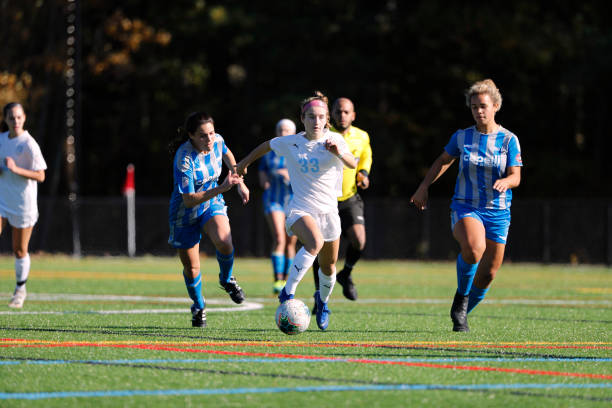
Women’s soccer has a larger NCAA footprint, with hundreds of programmes spread across Divisions I, II and III, while men’s soccer has fewer opportunities overall and therefore can be particularly competitive at certain levels.
For families coming through the elite youth club system, understanding the differences between ECNL and ECNL Regional League can also provide useful context when considering the level of competition and development environment a player is coming from.
The gender difference also matters when families discuss scholarships because Title IX and institutional scholarship structures influence how schools allocate athletics resources between men’s and women’s programmes.
The post-House Division I changes have also altered the scholarship landscape, with the NCAA noting that the new model can substantially increase the potential number of scholarships available to women because sport-specific scholarship maximums were removed for participating Division I schools.
Men’s Division I soccer is also moving toward a different season structure.
The NCAA Division I Men’s Soccer Oversight Committee adopted legislation in May 2026 that would move men’s soccer to a two-semester playing season beginning with the 2027-28 season, subject to the required review, while maintaining a maximum of 25 contests and introducing a spring championship segment.
That change could affect future recruiting conversations because the calendar, training rhythm and player workload will look different from the traditional fall-only structure.
Families comparing programmes should therefore pay attention to the year and ruleset attached to the information they are reading.
Playing Time Can Matter More Than Division
A recruit can become obsessed with the question of whether D1, D2 or D3 sounds best and overlook the issue that may affect their college experience most directly.
Playing time matters.
A player who joins a highly competitive D1 roster and spends two seasons barely entering matches may develop differently from a player who joins a strong D2 or D3 programme, earns meaningful minutes and receives consistent coaching responsibility.
That does not mean players should automatically choose the school where they will start as freshmen.
Development requires competition, and sometimes sitting behind an older player for a season can be extremely valuable when the environment is right.
The better questions concern the role the coaching staff sees for you.
Ask where you fit on the depth chart.
Ask which players currently occupy your position.
Ask how many recruits the programme is bringing into your class.
Ask what happened to players in your position during the previous recruiting cycles.
A coach who can explain your likely development pathway is giving you much more useful information than someone simply promising that you will “play a lot.”
The Time Commitment Is Serious at All Three Levels
Another misconception involves the idea that D3 soccer is casual while D1 soccer consumes every hour outside class.
The reality sits somewhere between those extremes.
All NCAA soccer players are college athletes first and must manage training, competition, travel, recovery, academics and ordinary student life.
Division I generally operates within the most demanding high-performance environments, with substantial expectations around training, preparation and travel.
Division II can provide a similarly serious athletic commitment while often giving athletes a different balance between sport and the rest of college life.
Division III places a stronger philosophical emphasis on allowing student-athletes to engage with academics and other campus opportunities alongside athletics, but D3 soccer remains competitive and can require a serious weekly commitment.
The important thing is to examine the actual programme.
Two D3 schools can feel completely different.
Two D1 schools can feel completely different.
The division gives you context, but the coaching staff, conference, roster, travel demands and institutional culture tell you what your daily life will actually look like.
Academic Fit Should Be Part of the Soccer Evaluation
A college soccer offer can look impressive until the academic side of the equation becomes uncomfortable.
That is why families should compare the school itself with the soccer programme.
Division I and Division II prospects must meet NCAA academic eligibility requirements, including core-course requirements and division-specific standards, while Division III schools establish their own academic admissions standards and have a different NCAA certification structure.
For D1, the NCAA currently lists a 2.3 minimum core-course GPA, while D2 uses a 2.2 minimum core-course GPA, although admission to a particular college can require much higher academic performance than the NCAA minimum.
That final point matters.
Being NCAA eligible does not mean being academically admissible.
A player might satisfy the NCAA standard and still not meet the admission profile of a highly selective university.
The strongest recruiting strategy therefore considers academics from the beginning rather than treating them as paperwork that appears after the soccer decision.
NAIA vs NCAA Soccer
Families should also look beyond the NCAA when building a complete college soccer list.
The NAIA vs NCAA soccer comparison is useful because the NAIA offers another pathway for athletes who want to compete in college, and its schools can provide athletic scholarships and other financial aid opportunities.
That means an athlete who does not find the right NCAA opportunity still has meaningful alternatives.
The same principle applies to junior colleges and other collegiate pathways.
A recruit should be building a college soccer plan rather than a Division I-only plan.
The goal is to find a place where the academic programme works, the financial package works, the soccer level challenges you and the coaching staff has a credible plan for your development.
Which Division Is Right for You?
There is no universal answer because the right division depends on the player.
A top-level prospect with strong academics who wants the highest possible athletic environment may thrive at a D1 school.
A player who wants serious college soccer, potential athletic aid and a little more flexibility in the overall structure may find D2 particularly attractive.
A recruit who values academics, campus involvement and a strong soccer programme without needing an athletic scholarship may find D3 to be an outstanding fit.
The best decision often becomes clearer when you stop asking which division sounds better and start comparing actual schools.
Look at the roster.
Study the conference.
Watch matches.
Research the coaching staff.
Check the academic programme.
Ask about financial aid.
Understand the travel schedule.
Find out how many players are in your position.
Then picture yourself there for four years.